Sunday, 11 December 2022

FOUR UNSUCCESSFUL EXPERIMENTS

M.elle le “Gladiator” is the fifth studio album by Franco Battiato and was released in 1975 on the Bla Bla label. When Battiato released this work he was influenced by American composer John Cage, a pioneer of chance music, non-standard use of musical instruments and electronic music and by Karlheinz Stockhausen, a German composer known for his work in electronic music and for introducing aleatory techniques into serial composition. As you can guess, this album is marked by a strong experimentalism, there are almost no traces of rock or pop and listening to it could be very difficult...


The album features only three instrumental tracks. The first one, “Goûtez and comparez” is a kind of fuzzy patchwork, just a long sequence of scattered sounds, bits of conversations and poems, hints of songs taken from radio broadcasts, music performed on piano or VCS3, percussion patterns or simple noises, all assembled together and blended with the collage technique... 


The Monreale Cathedral organ

The last two tracks, “Canto fermo” and “Orient effect”, are cuts taken from a pipe organ improvisation session recorded with poor means in the Monreale Cathedral, near Palermo. This particular church organ was built between 1957 and 1967 by the Ruffatti Brothers of Padua and it was the sole European organ with six keyboards with 61 keys each and 10 thousand pipes in wood and metal subdivided in three sounding bodies: a great instrument with a tremendous potential but, in my opinion, a weak performance...

On the whole, this is an album that might be recommended only to die-hard fans and collectors.

You can listen to it HERE

Franco Battiato: M.elle “Le Gladiator” (1975). Other opinions:
Michael Berry: Probably my favorite of his avant works of the middle to late 70's. In fact I enjoy and listen to this album more than Fetus and Pollution. Only behind Clic and Sulle Corde di Aries as my favorite 70's Battiato albums... (read the complete review HERE)


**************


Battiato is the sixth album by Franco Battiato and was released in 1977 on the Ricordi label. There’s no trace of rock on it, it’s pure avant-garde and experimentalism, a challenging work that is really hard to understand and appreciate. To be honest, I find it almost unbearable...


The first side of the original LP is entirely occupied by “Za”, a long piece for piano solo (here played by Antonio Ballista) that in the liner notes is described as follows: “Apparently poor. Almost completely based on one chord. Deliberately percussive (the right pedal is never used), it splits and subtracts resonances, with a release technique. It needs a listening that could be defined as meta-analytical, in favour of a timeless non-spatiality”. In my opinion, it’s just something that might drain out your all your patience as a music listener, drop after drop...

The second side of the LP is completely filled with another long experimental track, “Café-Table-Musik”, whose title derives from a phrase with which Marcel Proust had defined some of his books, i.e. coffee table books. It’s a kind of clumsy collage of sounds with soprano vocals, romantic piano patterns, fragments of dialogues, reciting voices and even treacherous hints of melody. This piece is described by the composer in the liner notes as a piece of European regression, a sort of Orphic-collage; full of substitutions, manipulations, false quotes, or rather original copies where the piano scale becomes melody, the exercise of voice, feeling... Freedom from the known for the known... In my opinion, it’s just another way to wear out your patience as a music listener, if any trace of patience was left after listening to the previous track...

On the whole, a deliberate sonic torture for your ears, but not without a kind of perverse, self-ironic charm.

Anyway, you can judge for yourselves by listening to the complete album HERE

Franco Battiato: Battiato (1977). Other opinions:
Michael Berry: It is great music for a rainy Sunday morning... just remember the headphones so your wife or girlfriend doesn't toss your stereo out the window... (read the complete review HERE)


**************


Juke Box is the seventh studio album by Franco Battiato and was released in 1978 on the Ricordi label. It was originally conceived as the soundtrack of a TV series about the life of Filippo Brunelleschi but eventually it wasn’t used to comment the scenes on the screen. Here Franco Battiato (vocals, piano) acts as a classical composer and avant-garde performer with the collaboration of Giusto Pio (violin), Juri Camisasca (vocals), Antonio Ballista (piano), Alide Maria Salvetta (soprano vocals) and Roberto Cacciapaglia (orchestra director). I fear, however, that the result of his efforts on this album might sound disappointing to most of the listeners...


The opener, “Campane” (bells) is a short, ethereal piece composed for soprano, violins and piano with a disquieting atmosphere. The following “Su scale” (On scales) is a piece for vocals, choir and two pianos that sounds like a whiny dirge... A disconcerting piece for two violins, “Martyre celeste”, closes the first side of album.

Side two opens with a piece for soprano and piano, “Hiver”, sung in French with lyrics taken from a poem by Fleur Jaeggy... “Sometimes in the twilight the monotony, but I was gentle / I complied with what I assumed was the order of the universe...”. Next comes “Agnus”, a piece for vocals, soprano, nine violins, two trumpets and piano. Its nice melodic lines will later find a better use in a track from the 1979 album L’era del cinghiale bianco entitled “Stranizza d’amuri”. Then, a long, irritating piece for solo violin entitled “Telegrafi” (Telegraphs) ends the album.

On the whole, just a soporific experiment...

You can listen to the album HERE

Franco Battiato: Juke Box (1978). Other opinions:
Allister Thompson: Battiato could not be accused of playing it safe, and his output in the mid-late 70s is definitely an acquired taste. Juke Box is actually fairly accessible compared with some of his other extreme minimalist recordings from that era. This is pretty much an ambient album of sparse, but not minimalist, compositions, for piano, strings and, at times, female voice... (read the complete review HERE)


**************


L’Egitto prima delle sabbie is the last album of Battiato’s experimental period and was released in 1978 on the Ricordi label. It's an instrumental work of extreme minimalism without the slightest trace of rock and featuring only two long tracks...
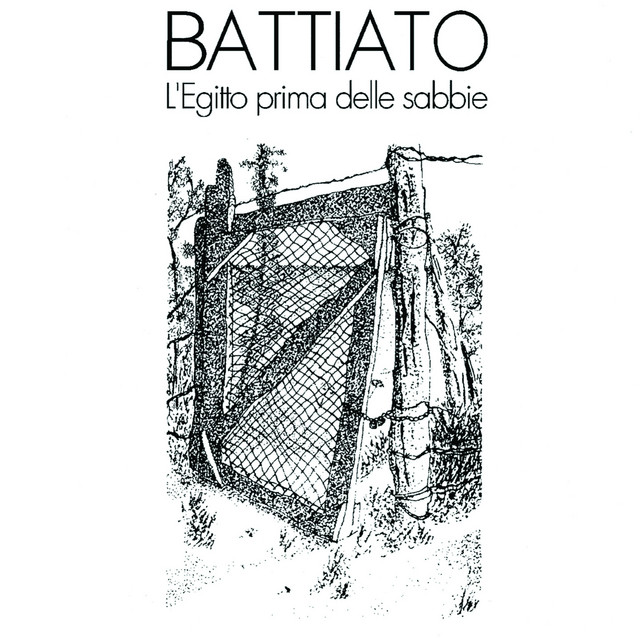


The title track is a piece for piano solo... Just one chord, a single short arpeggio repeated more and more times for almost fifteen minutes. It was a kind of research on the natural harmonic sounds generated by the first wave of notes played... It was awarded with the “Stockhausen Prize” but I fear that most of the progressive rock fans would find it boring to say the least...

The second track, “Sud Afternoon” is a piano duo composed by Battiato and performed by Antonio Ballista and Bruno Canino, two classical musicians. This composition is another piece of “contemporary classical minimalist avant-garde”, slightly more articulated than the previous one but in my opinion in the same bleak mood...

On the whole, an album that might be of some interest just for connoisseurs of contemporary classical avant-garde...

If you dare, listen to the complete album HERE

Franco Battiato: L’Egitto prima delle sabbie (1978). Other opinions:
David “Guldbamsen”: As a big fan of Franco Battiato and his ever changing sonic routes, this album completely threw me off balance. The man has always done things his own way, but the transition he made from his first four progressive rock albums to the minimalist approach found on subsequent albums made my head spin. I guess you could spot certain Stockhausen influences on an album like 'Clic', but they in no way prepared you for the white shimmering nothingness of this, his final minimalist installation, 'L'Egitto Prima Delle Sabbie'... (read the complete review HERE)


Friday, 9 December 2022

SEAS OF IRRATIONALITY

Clic is the fourth studio album by Franco Battiato and was released in 1974 on the Bla Bla label with a line up featuring, along with the Sicilian artist (piano, organ, VCS3, mandola, vocals), Gianni Mocchetti (guitar, bass), Gianfranco D’Adda (percussion), Juri Camisasca (vocal effects), Pietro Pizzamiglio (vocal effects) and the Quartetto Ensemble of Milan Conservatory directed by Luciano Bianco. The album is dedicated to Karlheinz Stockhausen and is the first of a series of works that many people find almost impossible listening to. On this album there’s no much room for rock and “to be progressive” here means most of all experimenting new sounds and effects. In this period Battiato became more and more involved in avant-garde and less and less interested in music business dynamics, the art cover by Mario Convertino reflects this minimalistic approach...


The opener “I cancelli della memoria” (The gates of the memory) is a piece with a mysterious, disquieting mood. It’s like a horror film soundtrack with sax lines appearing like a ghost before melting back into the mist and giving room to an interesting rhythm pattern...

Experimental sounds and reverse tapes introduce also the following “No U Turn”, the only track on this album featuring lyrics and a conventional vocal part. Here the artist depicts in some way his personal inner quest to knowledge and truth and his fight on the brink of madness against the haunting ghosts of anguish and fear... “To destroy old realities / I floated on seas of irrationality / I slept to not die / Throwing away my paper myths / On skies of schizophrenia...”. In my opinion this is the best track on the album and the closest one to the sound of Battiato’s previous works...


The third track, “Il mercato degli dei” (The god’s market), is a minimalist piece where synthesizer and piano arpeggios set an ethereal atmosphere, while the following “Rien ne va plus: andante” is just an experimental and almost self-ironic collage of classical music hints... Definitely unconventional but not completely convincing!

Another good piece is “Propriedad prohibida”, an interesting example of electronic music with a strong spacey flavour featuring strings and synthesizers while the last two tracks are frankly weak. “Nel cantiere di un’infanzia” (In the building site of a childhood), in my opinion, is just a clumsy mix of experimental sounds and Mediterranean melody and “Ethika fon ethika” is nothing more than a mix of scattered sounds put together with the collage technique...

On the whole, this is not an essential album, but it could be of some interest for Franco Battiato’s fans and experimental music lovers...

You can listen to the complete album HERE

 
Franco Battiato: Clic (1974). Other opinions:
Michael Berry: A dense ambient electronic album with some avant sections that hint broadly on where he would be heading in the years down the road. This album was the culmination of his early electronic period. The avant hints that were dropped in Sulle Corde di Aries are even more pronounced here, and possibly more fully realized. An incredible album. Not being particularly into the electronic side of prog I can't vouch for what Battiato did in comparison to others. In creativity or quality for that matter. All I know is what my ears tell me.. and they tell me that I love this album... (read the complete review HERE)


Thursday, 8 December 2022

ON MYTHICAL STRINGS

Franco Battiato started his career in the mid sixties as a beat singer. In the early seventies he turned to progressive and released some interesting albums as “Fetus” and “Pollution” then, with “Sulle corde di Aries” (On Aries’ strings), he began to turn from progressive to pure avant-garde. Nonetheless this album is absolutely worth listening to since here the experimental passages are well balanced with more melodic parts. The line-up features Franco Battiato (lead vocals, synthesizer VCS3, guitar, piano, calimba), Gianni Mocchetti (guitar, mandola, backing vocals) and Gianfranco D’Adda (percussion) plus many guests who helped enrich the sound.


The long opener “Sequenze e frequenze” (Sequences and frequencies) blends dark experimental sounds with oriental influences; hypnotic, unusual “filtered” vocals soar after more than two minutes and seem to be floating on a “flying musical carpet” while evoking memories from childhood... “In summer our teacher taught in her garden / I used to sit on a little wall looking towards the sea / Every now and again a ship passed by...”. Then the vocals give way to suggestive percussion patterns and to other experimental sounds. Quite interesting, even if for some this track could seem too long (sixteen minutes!) and in the end a little bit boring...

On the instrumental “Aries” you have more experimental sounds, percussions that seem to imitate a horse-ride and a jazzy sax outro. The atmosphere is ethereal and spacey. Well, Aries is the first sign of the zodiac and in some way it well represents this bold, futuristic track.


Next comes “Aria di rivoluzione” (Air of Revolution) which in my opinion is the best track on this album. Hidden and painful memories seem slowly coming afloat... “At that time in Europe there was another war / There were no songs but alarm hooters...”. Here Franco Battiato’s lead vocals in “Arab style” perfectly interact with the voice of Jutta Nienhaus (the singer of the German/Italian band Analogy) who recites some verses in German taken from “Genossen, wer von uns wäre nicht gegen den Krieg”, a poem by the German “Liedermacher” Wolf Biermann. The musical background is evocative... Policemen trained against the people are drowned in the crowd storming through the streets like a raging river... “My generation wants new ideals / I’ve already felt the revolution in the air / I’ve already heard who will be shot down...”.

The final track “Da Oriente ad Occidente” (From the East to the West) is like a musical journey from East to West, from Oriental influences to jazzy sounds... “Away from this darkness the future ripens / The sky is without clouds / Father please, let me set off...”.

You can listen to the complete album HERE 

From the book Rock Progressivo Italiano: an introduction to Italian Progressive Rock

Frano Battiato: Sulle corde di Aries (1973). Other opinions:
Jim Russell: All in all, the album has a very "holy" feel to it, a spiritual feel. It's like an ancient archeological find, a piece of art that is soothing and unsettling. It's about texture, ambiance, and mood... it is not about rock and roll songs. A masterpiece in my humble opinion... (read the complete review HERE)


Friday, 2 December 2022

BLEEDING MICROPHONES

Alan Sorrenti is the third, eponymous album by Alan Sorrenti and was released in 1974 on the Harvest label with a line up featuring Alan Sorrenti (vocals, acoustic guitar, synth), Toni Esposito (drums, percussion), Nero Limone (bass, electric guitar), Enzo Castella (acoustic guitar, mandolin) and Mark Harris (piano, acoustic guitar, synth) while Umberto Telesco took charge of the pictures for the art cover. With this work the musical approach of the Neapolitan artist started to change and the experimentalism of his previous two works begun to give way to simpler forms. The arrangements are good but not so bold and challenging as in the past while a melancholic vein is always present in the lyrics and in the melodies...


The opener, “Un viso d'inverno” (A face in winter), is an ethereal, acoustic ballad where the music and lyrics conjure up a black and white landscape. Time passes slowly among the trees, a pale sun shines behind the clouds and, as by magic, melts the ice on a wintry face... The vocals here are still used as an instrument but without taking too impervious paths.

Next comes the cover of the popular traditional Neapolitan song “Dicitencello vuje”, written in 1930 by Rodolfo Falvo and Enzo Fusco, here reinterpreted by Alan Sorrenti in a very personal way. It’s a man’s desperate declaration of love towards his beloved woman, made indirectly and passionately. This track was also released as a single and was very successful although it was considered a kind of treason by many of the old fans...


“Ma tu mi ascolti” (But you, are you listening to me?) is a melancholic, desperate ballad dealing with alienation and exclusion. The music and words depict the image of a homeless who seeks for help... “Now you know that I’m not strong / Now you know that I fear living... I am tired and I wish a home / The one who destroyed me now shows me the way / It was late winter when they tried to make me forget of myself / And I lost my way / I got lost...”.

“Sulla cima del mondo” (On the top of the world), is sarcastic track about vainglory, social climbing and careerism. Success might hide a huge spiritual void and infinite sadness. The lyrics depict a man on the terrace of a skyscraper from where the city below looks like a thriving anthill. He had to turn into a clown to play with the world... “But what do you want? / I don't want to feel pain any more / No, I don't want to suffer any more... You are running after the time / Because you want all in a while / And you will live crying / On the top of the world...”.


“Poco più piano” (A little slower) is an unconventional love song, with an arrangement featuring horns and strings, an oblique pace and almost hysterical vocals. The cryptic lyrics evoke bucolic landscapes and cloudy memories as the heart of the protagonist beats slower and slower...

“Microfoni assassini” (Killer microphones) is a disquieting piece that sounds like a surreal claim for artistic freedom... “Naked and trembling / Now I’m here / In front of killing microphones / In front of you, who are looking from your cage / At my bleeding mouth...”. Well, the early seventies were hard times for concerts in Italy and Alan Sorrenti was frequently contested by a turbulent public that in some occasions throw to him stones, empty bottles, fruits...

Then the dreamy “Incrociando il sole” (Crossing the sun) ends the album with suffused atmospheres and acoustic sounds. It brings a touch hope in a gloomy day... “Everyone is dead now / Everyone is older / But we are still together in the air / Crossing the sun...”.

On the whole, this work has its good moments and it could be of some interest for prog fans, but it's not an essential one.

You can listen to the complete album HERE


Thursday, 1 December 2022

SMELLS OF INCENSE AT DAWN

Come un vecchio incensiere all’alba di un villaggio deserto is the second album by Alan Sorrenti and was released in 1973 on the Harvest label. It was recorded in London with a line up featuring, along with Alan Sorrenti (vocals, acoustic guitar, synth), also Toni Esposito (percussion, drums, cymbals, bells), Ron Mathienson (contrabass), Francis Monkman (from Curved Air - synthesizer, piano, guitar), Mario D’Amora (piano), Toni Marcus (violin, viola), David Jackson (from Van Der Graaf Generator - flute) and Victor Bell (cello) while Umberto Telesco took care of the art work. The follow-up of the beautiful Aria might not be as good as its predecessor but it is not without interest for prog lovers. Alan Sorrenti’s experimental vocals are still in the forefront exploring new territories even if the music doesn’t reach the same peaks of intensity of Aria and the lyrics, in my opinion, are less inspired...


The opener is a dark, acoustic ballad, “Angelo” (Angel), featuring excellent flute passages and a suggestive percussion work. The lyrics describe in a visionary way a painful wait and a broken promise, fragments of dreams and tormented memories...

The following “Serenesse” deals in a poetical way with the difficulty to communicate with other people. Hate and fear are like a ditch that you have to cross walking on a thin tree trunk to reach the other side where you can find love and peace. This song was also released as a single and probably is the most accessible on the album with its joyful violin plying and the flute that counter points the vocal lines...

“Una luce si accende” (A light turns on) is a melancholic ballad featuring some delicate violin passages... “A light turns on / And already you can hear a lover’s kiss / And what am I if I have not the boldness to love? / What have I if I haven't got the courage to love?”. It's not exactly a love song but a song about the emptiness provoked by the lack of love...


“Oratore” (Speaker) is an experimental, acoustic track featuring good melodic hints and foggy lyrics drawing mystic visions and psychedelic dreams... “The sun was looking at us from the other side of the motorway / While you, speaker, were talking...”. Well, sometimes speeches can be meaningless and this track in my opinion is not completely convincing...

Next comes “A te che dormi” (For you who are sleeping), where on an acoustic strumming guitar background soaring unquiet vocals weave a troubling lullaby... “Sleep, you’ll find me deep inside the lake / While I’m playing with the moon / That hides herself when you arrive...”.

The title track, “Come un vecchio incensiere all’alba di un villaggio deserto” (Like an old incensory at dawn in a deserted village) is a long suite that ends the album. Despite the excellent work of percussionist Toni Esposito and some good melodic lines I find it somehow confused, with too many experiments and maybe not enough substance. It’s about death and rebirth from the ashes, but it comes out like a mystical patchwork that lacks of melodic coherence and, in my opinion, risks to lead to boredom...

On the whole, I think that this is a good work but not an essential one.

You can listen to the complete album HERE