Showing posts with label Catania. Show all posts

Sunday, 11 December 2022

FROM AVANT-GARDE TO NEW HORIZONS

In 1979, after some years of soporific avant-garde, Franco Battiato woke up and turned his attention to the public. Don’t worry, “L’era del cinghiale bianco” is not just an easy pop album or a bleak effort to reach commercial success... In that period the “Halcyon days” of prog were gone and Franco Battiato, as many other artists, was looking for new musical ways. Here classical music and Mediterranean and Middle-Eastern folk influences blend with rock and pop in a very personal way, with the help of a group of excellent musicians. The lyrics don’t tell stories but the words are just like “flashes” trying to suggest the images... The final result is surprisingly good!


The wild white boar is a symbol taken from the Celtic mythology and in some way the weird lyrics of the opener title track (“L’era del cinghiale bianco” means “The age of the wild white boar”) seem to invoke the return to a new spiritual era of knowledge and wisdom... This is one of the best known of Battiato’s songs and it features a great interaction between the violin of Giusto Pio and the guitar of Alberto Radius (former guitarist of Formula Tre and Il Volo). The instrumental riff is very catchy and it leaves you hoping that “the age of the wild white boar will come back soon...”.

Mysticism for sale... The following “Magic Shop” is about money and religion: the ironic lyrics draw a caustic criticism against the habit of making money from faith, while the music is light and deep with a good line of bass and soaring vocals... “Can’t you see that the Golden Age was just a shadow of Wall Street?”.

Strade dell’Est” (Roads of the East) is a kind of musical journey on the streets of the East, from Albania to Siberia, from China to Iraq, from Turkey to Russia. The percussion work of Tullio De Piscopo and the guitar solo of Alberto Radius are great and the result is an extremely interesting mix of rock and folk influences... “Roads of the East, immense horizons / Hidden cities of Persian language... They tell stories of princesses locked in castles for their great beauty...”.


Luna indiana” (Indian moon) is an instrumental track with classical influences and a nocturnal mood where the interacting of piano and violin weave a “chamber music” atmosphere, the murmured vocals appearing at the end of the track seem to introduce the slow, magical mood of the following “Il re del mondo” where “the king of the world keeps our hearts in prison...”.

Next comes the ethereal, mystic “Pasqua Etiope” (Ethiopic Easter). It is sung in Latin and sounds like a kind of exotic prayer... “Requiem aeternam dona eis Domine et lux perpetua luceat eis...”.

The last track “Stranizza d’amuri” (Love strangeness) is sung in the dialect of Sicily and features a good percussion work and a “Mediterranean flavour” while the suggestive lyrics conjure up memories of first love.

The album is short (it lasts only 31 minutes) but every track is worth listening to. In fact “L’era del cinghiale bianco” is still far from the clever pop of Battiato’s successive albums and on the whole I think that it could be an excellent addition to an Italian prog collection...

You can listen to the complete album HERE

Franco Battiato: L’era del cinghiale bianco (1979). Other opinions:
Raffaella Benvenuto-Berry: While prog purists may frown upon Battiato's move, open-minded music fans will find a lot to love in this intriguing, sophisticated album. In spite of its superficial 'poppy' feel, L'era del cinghiale bianco has many layers, which will unfold upon repeated listens. Granted, it is not 'conventional' prog by any means, and as such may be found disappointing by those who expect 20-minute epics, or wild time signature shifts... (read the complete review HERE).
 

FOUR UNSUCCESSFUL EXPERIMENTS

M.elle le “Gladiator” is the fifth studio album by Franco Battiato and was released in 1975 on the Bla Bla label. When Battiato released this work he was influenced by American composer John Cage, a pioneer of chance music, non-standard use of musical instruments and electronic music and by Karlheinz Stockhausen, a German composer known for his work in electronic music and for introducing aleatory techniques into serial composition. As you can guess, this album is marked by a strong experimentalism, there are almost no traces of rock or pop and listening to it could be very difficult...


The album features only three instrumental tracks. The first one, “Goûtez and comparez” is a kind of fuzzy patchwork, just a long sequence of scattered sounds, bits of conversations and poems, hints of songs taken from radio broadcasts, music performed on piano or VCS3, percussion patterns or simple noises, all assembled together and blended with the collage technique... 


The Monreale Cathedral organ

The last two tracks, “Canto fermo” and “Orient effect”, are cuts taken from a pipe organ improvisation session recorded with poor means in the Monreale Cathedral, near Palermo. This particular church organ was built between 1957 and 1967 by the Ruffatti Brothers of Padua and it was the sole European organ with six keyboards with 61 keys each and 10 thousand pipes in wood and metal subdivided in three sounding bodies: a great instrument with a tremendous potential but, in my opinion, a weak performance...

On the whole, this is an album that might be recommended only to die-hard fans and collectors.

You can listen to it HERE

Franco Battiato: M.elle “Le Gladiator” (1975). Other opinions:
Michael Berry: Probably my favorite of his avant works of the middle to late 70's. In fact I enjoy and listen to this album more than Fetus and Pollution. Only behind Clic and Sulle Corde di Aries as my favorite 70's Battiato albums... (read the complete review HERE)


**************


Battiato is the sixth album by Franco Battiato and was released in 1977 on the Ricordi label. There’s no trace of rock on it, it’s pure avant-garde and experimentalism, a challenging work that is really hard to understand and appreciate. To be honest, I find it almost unbearable...


The first side of the original LP is entirely occupied by “Za”, a long piece for piano solo (here played by Antonio Ballista) that in the liner notes is described as follows: “Apparently poor. Almost completely based on one chord. Deliberately percussive (the right pedal is never used), it splits and subtracts resonances, with a release technique. It needs a listening that could be defined as meta-analytical, in favour of a timeless non-spatiality”. In my opinion, it’s just something that might drain out your all your patience as a music listener, drop after drop...

The second side of the LP is completely filled with another long experimental track, “Café-Table-Musik”, whose title derives from a phrase with which Marcel Proust had defined some of his books, i.e. coffee table books. It’s a kind of clumsy collage of sounds with soprano vocals, romantic piano patterns, fragments of dialogues, reciting voices and even treacherous hints of melody. This piece is described by the composer in the liner notes as a piece of European regression, a sort of Orphic-collage; full of substitutions, manipulations, false quotes, or rather original copies where the piano scale becomes melody, the exercise of voice, feeling... Freedom from the known for the known... In my opinion, it’s just another way to wear out your patience as a music listener, if any trace of patience was left after listening to the previous track...

On the whole, a deliberate sonic torture for your ears, but not without a kind of perverse, self-ironic charm.

Anyway, you can judge for yourselves by listening to the complete album HERE

Franco Battiato: Battiato (1977). Other opinions:
Michael Berry: It is great music for a rainy Sunday morning... just remember the headphones so your wife or girlfriend doesn't toss your stereo out the window... (read the complete review HERE)


**************


Juke Box is the seventh studio album by Franco Battiato and was released in 1978 on the Ricordi label. It was originally conceived as the soundtrack of a TV series about the life of Filippo Brunelleschi but eventually it wasn’t used to comment the scenes on the screen. Here Franco Battiato (vocals, piano) acts as a classical composer and avant-garde performer with the collaboration of Giusto Pio (violin), Juri Camisasca (vocals), Antonio Ballista (piano), Alide Maria Salvetta (soprano vocals) and Roberto Cacciapaglia (orchestra director). I fear, however, that the result of his efforts on this album might sound disappointing to most of the listeners...


The opener, “Campane” (bells) is a short, ethereal piece composed for soprano, violins and piano with a disquieting atmosphere. The following “Su scale” (On scales) is a piece for vocals, choir and two pianos that sounds like a whiny dirge... A disconcerting piece for two violins, “Martyre celeste”, closes the first side of album.

Side two opens with a piece for soprano and piano, “Hiver”, sung in French with lyrics taken from a poem by Fleur Jaeggy... “Sometimes in the twilight the monotony, but I was gentle / I complied with what I assumed was the order of the universe...”. Next comes “Agnus”, a piece for vocals, soprano, nine violins, two trumpets and piano. Its nice melodic lines will later find a better use in a track from the 1979 album L’era del cinghiale bianco entitled “Stranizza d’amuri”. Then, a long, irritating piece for solo violin entitled “Telegrafi” (Telegraphs) ends the album.

On the whole, just a soporific experiment...

You can listen to the album HERE

Franco Battiato: Juke Box (1978). Other opinions:
Allister Thompson: Battiato could not be accused of playing it safe, and his output in the mid-late 70s is definitely an acquired taste. Juke Box is actually fairly accessible compared with some of his other extreme minimalist recordings from that era. This is pretty much an ambient album of sparse, but not minimalist, compositions, for piano, strings and, at times, female voice... (read the complete review HERE)


**************


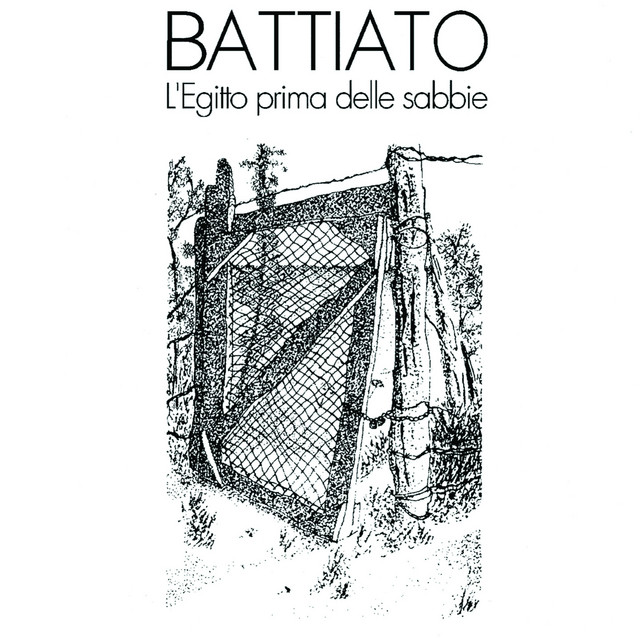
L’Egitto prima delle sabbie is the last album of Battiato’s experimental period and was released in 1978 on the Ricordi label. It's an instrumental work of extreme minimalism without the slightest trace of rock and featuring only two long tracks...


The title track is a piece for piano solo... Just one chord, a single short arpeggio repeated more and more times for almost fifteen minutes. It was a kind of research on the natural harmonic sounds generated by the first wave of notes played... It was awarded with the “Stockhausen Prize” but I fear that most of the progressive rock fans would find it boring to say the least...

The second track, “Sud Afternoon” is a piano duo composed by Battiato and performed by Antonio Ballista and Bruno Canino, two classical musicians. This composition is another piece of “contemporary classical minimalist avant-garde”, slightly more articulated than the previous one but in my opinion in the same bleak mood...

On the whole, an album that might be of some interest just for connoisseurs of contemporary classical avant-garde...

If you dare, listen to the complete album HERE

Franco Battiato: L’Egitto prima delle sabbie (1978). Other opinions:
David “Guldbamsen”: As a big fan of Franco Battiato and his ever changing sonic routes, this album completely threw me off balance. The man has always done things his own way, but the transition he made from his first four progressive rock albums to the minimalist approach found on subsequent albums made my head spin. I guess you could spot certain Stockhausen influences on an album like 'Clic', but they in no way prepared you for the white shimmering nothingness of this, his final minimalist installation, 'L'Egitto Prima Delle Sabbie'... (read the complete review HERE)


Friday, 9 December 2022

SEAS OF IRRATIONALITY

Clic is the fourth studio album by Franco Battiato and was released in 1974 on the Bla Bla label with a line up featuring, along with the Sicilian artist (piano, organ, VCS3, mandola, vocals), Gianni Mocchetti (guitar, bass), Gianfranco D’Adda (percussion), Juri Camisasca (vocal effects), Pietro Pizzamiglio (vocal effects) and the Quartetto Ensemble of Milan Conservatory directed by Luciano Bianco. The album is dedicated to Karlheinz Stockhausen and is the first of a series of works that many people find almost impossible listening to. On this album there’s no much room for rock and “to be progressive” here means most of all experimenting new sounds and effects. In this period Battiato became more and more involved in avant-garde and less and less interested in music business dynamics, the art cover by Mario Convertino reflects this minimalistic approach...


The opener “I cancelli della memoria” (The gates of the memory) is a piece with a mysterious, disquieting mood. It’s like a horror film soundtrack with sax lines appearing like a ghost before melting back into the mist and giving room to an interesting rhythm pattern...

Experimental sounds and reverse tapes introduce also the following “No U Turn”, the only track on this album featuring lyrics and a conventional vocal part. Here the artist depicts in some way his personal inner quest to knowledge and truth and his fight on the brink of madness against the haunting ghosts of anguish and fear... “To destroy old realities / I floated on seas of irrationality / I slept to not die / Throwing away my paper myths / On skies of schizophrenia...”. In my opinion this is the best track on the album and the closest one to the sound of Battiato’s previous works...


The third track, “Il mercato degli dei” (The god’s market), is a minimalist piece where synthesizer and piano arpeggios set an ethereal atmosphere, while the following “Rien ne va plus: andante” is just an experimental and almost self-ironic collage of classical music hints... Definitely unconventional but not completely convincing!

Another good piece is “Propriedad prohibida”, an interesting example of electronic music with a strong spacey flavour featuring strings and synthesizers while the last two tracks are frankly weak. “Nel cantiere di un’infanzia” (In the building site of a childhood), in my opinion, is just a clumsy mix of experimental sounds and Mediterranean melody and “Ethika fon ethika” is nothing more than a mix of scattered sounds put together with the collage technique...

On the whole, this is not an essential album, but it could be of some interest for Franco Battiato’s fans and experimental music lovers...

You can listen to the complete album HERE

 
Franco Battiato: Clic (1974). Other opinions:
Michael Berry: A dense ambient electronic album with some avant sections that hint broadly on where he would be heading in the years down the road. This album was the culmination of his early electronic period. The avant hints that were dropped in Sulle Corde di Aries are even more pronounced here, and possibly more fully realized. An incredible album. Not being particularly into the electronic side of prog I can't vouch for what Battiato did in comparison to others. In creativity or quality for that matter. All I know is what my ears tell me.. and they tell me that I love this album... (read the complete review HERE)


Thursday, 8 December 2022

ON MYTHICAL STRINGS

Franco Battiato started his career in the mid sixties as a beat singer. In the early seventies he turned to progressive and released some interesting albums as “Fetus” and “Pollution” then, with “Sulle corde di Aries” (On Aries’ strings), he began to turn from progressive to pure avant-garde. Nonetheless this album is absolutely worth listening to since here the experimental passages are well balanced with more melodic parts. The line-up features Franco Battiato (lead vocals, synthesizer VCS3, guitar, piano, calimba), Gianni Mocchetti (guitar, mandola, backing vocals) and Gianfranco D’Adda (percussion) plus many guests who helped enrich the sound.


The long opener “Sequenze e frequenze” (Sequences and frequencies) blends dark experimental sounds with oriental influences; hypnotic, unusual “filtered” vocals soar after more than two minutes and seem to be floating on a “flying musical carpet” while evoking memories from childhood... “In summer our teacher taught in her garden / I used to sit on a little wall looking towards the sea / Every now and again a ship passed by...”. Then the vocals give way to suggestive percussion patterns and to other experimental sounds. Quite interesting, even if for some this track could seem too long (sixteen minutes!) and in the end a little bit boring...

On the instrumental “Aries” you have more experimental sounds, percussions that seem to imitate a horse-ride and a jazzy sax outro. The atmosphere is ethereal and spacey. Well, Aries is the first sign of the zodiac and in some way it well represents this bold, futuristic track.


Next comes “Aria di rivoluzione” (Air of Revolution) which in my opinion is the best track on this album. Hidden and painful memories seem slowly coming afloat... “At that time in Europe there was another war / There were no songs but alarm hooters...”. Here Franco Battiato’s lead vocals in “Arab style” perfectly interact with the voice of Jutta Nienhaus (the singer of the German/Italian band Analogy) who recites some verses in German taken from “Genossen, wer von uns wäre nicht gegen den Krieg”, a poem by the German “Liedermacher” Wolf Biermann. The musical background is evocative... Policemen trained against the people are drowned in the crowd storming through the streets like a raging river... “My generation wants new ideals / I’ve already felt the revolution in the air / I’ve already heard who will be shot down...”.

The final track “Da Oriente ad Occidente” (From the East to the West) is like a musical journey from East to West, from Oriental influences to jazzy sounds... “Away from this darkness the future ripens / The sky is without clouds / Father please, let me set off...”.

You can listen to the complete album HERE 

From the book Rock Progressivo Italiano: an introduction to Italian Progressive Rock

Frano Battiato: Sulle corde di Aries (1973). Other opinions:
Jim Russell: All in all, the album has a very "holy" feel to it, a spiritual feel. It's like an ancient archeological find, a piece of art that is soothing and unsettling. It's about texture, ambiance, and mood... it is not about rock and roll songs. A masterpiece in my humble opinion... (read the complete review HERE)


Friday, 19 June 2015

UNDER THE RAIN

Trasparenze is the fifth studio album by Malibran, a band from Catania whose roots date back to 1987. It was released in 2009 on the independent label Electromantic, more than seven years after its predecessor Oltre l'ignoto. Although it was originally conceived as a solo project of the leader and multi-instrumentalist Giuseppe Scaravilli, later other members of the band joined him during the recording sessions and eventually this excellent work was released under the name Malibran with a line up featuring Giuseppe Scaravilli (vocals, acoustic and electric guitar, flute, bass, keyboards), Jerry Litrico (guitar) and Alessio Scaravilli (drums) plus the guests Giancarlo Cutuli (sax) and Toni Granata (violin). Of course, here composer and lyricist Giuseppe Scaravilli does the lion's share playing almost all the instruments but the result is in perfect continuity with the band sound. In the booklet you can find extended liner notes that explain the genesis of each track while the art cover is taken from a painting by Karl Friedrich Schinkel that in some way describes the spirit of this work...


The opener is the title track, "Trasparenze" (Transparencies), a complex suite with many changes in rhythm and mood featuring some passages that could recall Genesis or Jethro Tull. It's about the passing of time... All along your life there's something or someone that attracts you and shows you the way you have to follow with its perfumes and its fire. You have to go on and on as your age flows away like a short poem, between dreams and reality, led by your will and by the flames of that fire...

Next comes the dreamy "In un attimo" (In a while). It starts with strummed guitar and flute, then the music and lyrics conjure up a long awaited, timeless moment of peace. You have in front of you a white canvas that your are going to fill with the colours of your dreams... You are painting a magic landscape and your soul is flying over there. Your troubles are left behind and you can smile, forgetting for a moment all the problems of everyday life, your mind is already over there...


"Vento d'Oriente" (Wind from the East) features a mysterious, exotic flavour. Heavy electric guitar riffs are mixed with Mediterranean influences while the music and lyrics evoke distant deserts and ancient sands, lost identities and empty realities. Listen to the voice of the wind blowing from the East, it carries echoes of ancient songs and whispers mysterious charms...

"Presagio" (Omen) alternates calm, pastoral sections to heavy riffs and Latin rock passages. It tells of obscure presages looming on the horizon like the thundering sound of the rapids ahead while you are swimming on the calm waters of a river, cradled by the current. Well, you've better keep calm and fight against all the adversities of life without fear...


"Pioggia di maggio" (Rain of May) is a beautiful, dreamy instrumental track full of soaring, delicate melodies. It leads to "La marea" (The tide) that tells in music and words of the contrast between the need to go away searching for a better way of life and the responsibilities that prevent you from leaving, keeping you tightly bound to your routine. You know you have to stay but you feel a strange emptiness growing inside you, maybe one day or another you'll turn your glance back and you'll start running after an idea, following dreams and ideals, drifting with the tide towards new horizons...

"Nel Ricordo" (In the memory) is about the power of fate. Your future turns around you like a dark shadow from whom you can't escape, you'll soon forget who you are because you're already changing and moving forward, you can't help it! The days and the nights you spent are like circles in the water that soon will fade away, the past is going to melt in your memory, you can't cheat on destiny...


"Volo Magico" (Magic flight) is a short instrumental track that conveys a strange sense of mystery. You can hear the sound of the bumblebees around you as you're flying from flower to flower under the charm of exotic perfumes and colourful landscapes... It leads to the nocturnal atmospheres of "Promesse vane" (Vain promises), a piece about a man who feels like an eternal boy and finds difficult to accept his everyday life and the burden of time passing by. Where are the promises of his childhood, what is left of his old dreams? He's burning out and nothing but his fantasy and imagination can set him free from the metaphorical chains of reality and make him happy, at least for a while...

The short, dreamy "Gioco di specchi" (Game of mirrors) is a nice instrumental track that introduces the wonderful suite that closes the album, "Pensieri fragili" (Fragile thoughts), a long, complex piece that every now and again recalls Arti & Mestieri and begins by the sound of a pouring rain... Here the music and lyrics take you back in time to World War I, in a trench along the front between the Kingdom of Italy and the Austro-Hungarian Empire. Under the rain the thoughts of a young infantry soldier unfurl while the water washes away a desperate night of waiting. Around the soldier there is nothing but mud and fog but he dreams of enchanted valleys and smiling faces that now seem just faded memories... A thousands eyes observe the human fragility from the sky, the soldier feels that the real enemy is inside him, he wants to give up not because of cowardice but because he feels that this war is not his own business. He doesn't care about honour and glory and in the fog he gets stealthily out of his shelter and runs for his life, disappearing in the rain...

On the whole, I think that this is a wonderful album without weak moments that will not disappoint Italianprog fans...

Malibran: Trasparenze (2009). Other opinions:
Chris "Seventhsojourn": Trasparenze is a long album that clocks in at 78-minutes, so you get your money's worth. There's not even much filler on it, with maybe just a couple of slightly weaker songs. My one criticism is that the album is a bit light on keyboards, but the loads of great flute you usually get with Malibran offset this... (read the complete review HERE)

More info:

Saturday, 28 February 2015

RAGE AGAINST THE MACHINE

Pollution is Franco Battiato's second album and was released in 1973 on the independent label Bla Bla Records. During the recording sessions Franco Battiato took charge of vocals and synthesizers and the line up was completed by Gianni Mocchetti (bass, vocals), Gianfranco D'Adda (drums, percussion), Roberto Cacciapaglia (synthesizer, piano) and Mario "Ellepi" Dalla Stella (guitars, vocals). This album, as its predecessor Fetus, features a provocative art work by Italian graphic artist and cultural agitateur Gianni Sassi. The inner sleeve contains a picture of the band with Gianni Sassi and his wife and the mysterious copy of a manifesto of an imaginary agency, the International Centre of Magnetic Studies, announcing an experiment that would have switched off for twenty-four hours all the internal combustion engines circulating in Italy...

art cover

As you can guess the content of the music and lyrics involves environmental issues and a poignant criticism against the industrialized world. Anyway, despite the subject matter, this is probably the most easy and accessible album of Franco Battiato's "prog period". Here all the tracks are bound together and form a long suite with recurring themes holding it together. The opener "Il silenzio del rumore" (The silence of the noise) begins by the echoes of a Viennese waltz by Strauss, then comes Battiato's recitative voice that in some way tries to wake you up from a sleepy, passive life-style characterized by addiction to noise and where people don't think with their own head and can't perceive the importance of being free and independent... "Have you ever been wondering / What is your function?". A "percussive" rhythm guitar and a church organ follow and lead to the sonic explosion of "31 dicembre 1999 - ore 9", just a few seconds of musique concrete. In the aftermath the sound of keyboards introduces the theme of the following "Areknames", that goes on with strange vocals and "experimental" lyrics written in "reverse style" (for example Areknames = Se mancherà). 


It leads to "Beta", where you can listen to sound effects and recitative vocals that conjure up a "mystical mood" while the piano plays some notes of the previous theme. The lyrics are based upon the novel Brave New World by Aldous Huxley. In the novel, from birth, people are genetically designed to fit into one of five castes, which are further split into 'Plus' and 'Minus' members and designed to fulfil predetermined positions within the social and economic strata of the World State. Fetuses chosen to become members of the highest castes, 'Alpha' and 'Beta', are allowed to develop naturally and are given stimulants while maturing to term in 'decanting bottles'. Fetuses chosen to become members of the lower castes of 'Gamma', 'Delta' or 'Epsilon' are subjected to in situ chemical interference to cause arrested development in intelligence and physical growth. Here we can listen for a moment to the voice of a happy Beta, interpreted by Franco Battiato with poignant irony. A short orchestral passage taken from a symphonic poem by Smetana ends the first side of the original Lp while a question arises... "Inside of me some micro organisms live my identical life without knowing that they belong to my body / I, what body do I belong to ?".

inner sleeve

The second side of the original album is divided into three tracks. The first is the dark, surreal "Plancton" that describes in music a words a kind of evolution in reverse, a regression from the human form to the shape of a strange sea creature. Hands become scales, hair become algae... Then a weird "space tarantella" passage leads on a solitary beach where you can hear the sound of the waves... Here you can listen to a nice, dreamy melody and to a strummed acoustic guitar, then soaring vocals evoke formulas used in physics and engineering, fluids dynamics and hydrometry... In fact, on the next track, "Pollution", the music and lyrics conjure up magnetic fields and expanding gas in a world formed by atoms and molecules that follow the rules of physics. The melancholic instrumental "Ti sei mai chiesto che funzione hai?" (Have you ever been wondering what is your function?) ends the album mixing regretful laments and whining with echoes of classical music. It seems to forecast a gloomy fate for a human race victim of his knowledge and technology...


Franco Battiato: Pollution (1973). Other opinions:
Michael Berry: A step forward here? oh yes.. take an afternoon and listen to his albums chronologically. Fetus was mainly a showcase and a first draft if you will for Battiato and his minimalist aspirations for composition and instrumentation. His VCS3 was the 'star' of the album... other instruments were mainly for texture other than the violin of Cariocinesi. Here, both compositionally and of curse in instrumentation Battiato has stepped forward... A wonderful album with some POWERFUL moments and I find the contrast this album represents fascinating. Highly recommended and may be the best place for new fans of Battiato to start... (read the complete review HERE)
Jim Russell: This is pure RPI (in spirit, if not in peer conformity) with all of the experimental flair so common in the genre, influenced by spacey English psych and Krautrock I would guess. Battiato's first three albums are all very high quality but different enough to make each essential listening for RPI fans in search of a deep collection. He is certainly more eccentric and weird than the symphonic giants like Orme, so if you are an RPI noob, be warned he may take some getting used to. But if you like outlandish sounds and trippy aural festivities, Battiato will not disappoint you... (read the complete review HERE)

Monday, 2 September 2013

BACK TO THE NEW WORLD

After some singles in a melodic, commercial style, in 1972 Franco Battiato took a more challenging musical direction for his first full length album on Bla Bla Records blending Italian melody with experimental electronic sounds. The result is “Fetus”, a concept album written in collaboration with Sergio Albergoni and producer Pino Massara and recorded with the help of a team of skilled musicians featuring, among others, Gianfranco D'Adda, Gianni Mocchetti and Sergio Almangano. According to the liner notes, this album is “completely dedicated” to Aldous Huxley and his works, in particular to Brave New World, a novel which anticipates developments in reproductive technology, sleep-learning, psychological manipulation, and operant conditioning that combine to profoundly change society. It's subtitled “Ritorno al mondo nuovo” (Return To The New World) and features a provocative, controversial art work by Gianni Sassi.


The opener “Fetus” is a short track in three parts that begins just by vocals and sound effects evoking the heart-beat. The lyrics depict the feelings of a baby who slowly takes shape in his mother's womb... “I wasn't born yet / And I could already feel the heart-beat / Even before my birth / I could feel that I was born without love...”. On the instrumental middle section synthesizers come in describing the mystery of life flowing in the veins of fate, then an acoustic guitar arpeggio introduces an almost mystical atmosphere.

The following “Una cellula” (A cell) features a dreamy mood while the lyrics conjure up images from a future where time gets blurred... “My cells will change and my body will have a new life... We will travel around the sun, faster than light / As time-machines against the will of Time...”.
 
Cariocinesi” (Mitosis) is a strange, swinging track that every now and again reminds me of the Quintette du Hot Club de France of Stephan Grappelli and Django Reinhardt. The music and lyrics describe in a surreal way the magic of the process by which a cell, which has previously replicated each of its chromosomes, separates the chromosomes in its cell nucleus into two identical sets of chromosomes, each set in its own new nucleus, a process that is maybe blind or just “enlightened by a memory without past...”. But beware! Chance can alter the process leading to unpredictable effects.


Energia” (Energy) begins with the voice of some little children in the background and the reprise of the theme of the middle section of the title track. Then Franco Battiato's vocals come in and draw some reflections about the role of chance in the reproductive process... “I have had many women in my life / And in every room I left some of my energy... If a child would be aware that he was born by chance among thousands of occasions / He would understand all the dreams that life can give / And he would live with joy all those illusions...”.

Fenomenologia” (Phenomenology) begins with a strummed acoustic guitar and a dreamy mood... “My mental action is uncertain / The voice is marble and concrete / I live in spite of myself / It’s hard to get the control / There’s fog around my eyes / The outlines are getting blurred / I’ve already forgotten my dimension / Unknown forces are tearing me from myself...”. Then a second part follows introduced by strange percussion patterns while the vocals repeat the DNA formula. The track ends with a reprise of the third part of the title track

Meccanica” (Mechanics) is darker and begins with synthesizers in the forefront that bring a sense of tension. Then an acoustic section follows and the music and lyrics depict a laboratory where the genes of love are manipulated to shape a new form of life featuring mechanical eyes and brain, a plastic heart and a synthetic taste. On the final section you can hear the voices of the astronauts of the Apollo 11 and Bach's “Air on a G string”.

Inner sleeve

Next comes the ethereal “Anafase” (Anaphase). Anaphase is the stage of mitosis or meiosis when chromosomes are split and the sister chromatids move to opposite poles of the cell, but in this case the lyrics and music conjure up an interstellar journey. Some spaceships take off towards the immensity - Will man colonize new planets?

The conclusive “Mutazione” (Mutation) seems to suggest the answer for the previous question... “Millennia of sleep have cradled me and now I'm back / Something has changed / I can't see any signal of life / Nonetheless I can feel it / The are some vibrations / I can't say what my eyes are going to see / Perhaps some bodies of stone / I feel them coming...”.

Well, on the whole an interesting album with a concept half-way between science-fiction and spiritualism!

You can listen in streaming to the complete album HERE

Franco Battiato: Fetus (1972). Other opinions:
Jim Russell: Despite the less-than-appealing cover art, "Fetus" is one charming piece of work. It is true that it is less realized than his coming albums, perhaps more scattershot, and yet I find it is probably the one I enjoy playing the most. It's a collage work mixing symphonic, psych, traditional Italian pop, avant-garde, minimalism, and electronic sound... As for what "Fetus" delivers to the listeners, the songs are short and sweet, built upon the combination of Battiato's VCS3, voice, and the acoustic guitar. The eerie warbles of the VCS3 are handled masterfully, and even if occasionally cheesy by today's standards they are often evocative and haunting in their strangeness. The embellishments in the form of violin, swelling organ washes, light/minimal percussion, Bach samples, and sound effects keep each track very rich and interesting... (read the complete review HERE)

Wednesday, 28 September 2011

SICILIA

It’s time now to challenge Scylla and Charybdis crossing the Strait of Messina. We begin in this way our visit to SICILIA, an island and an autonomous region of Italy. First we visit the city of MESSINA, where William Shakespeare’s comedy Much Ado About Nothing is set. Here we can listen to Addamanera (MySpace), a band that blends folk and psychedelia in an original way, then to the solo project of Antonino Rampulla (MySpace), to the young Moon Fire (MySpace) and to some post rock bands such as Denied Light (MySpace) and The Morning Light (MySpace). Not far from Messina lies the town of Milazzo home to Taberna Mylaensis (MySpace), a band that should be of interest to folk prog lovers and active since 1975.


Then we head south along the coast until we arrive at the small town of Santa Teresa di Riva, near the beautiful ancient town of Taormina, where we can listen to Conqueror (MySpace), an excellent contemporary prog band that in 2010 released a beautiful concept album, Madame Zelle, inspired by the adventurous life of a woman called Margaretha Geertruida Zelle, also known as Mata Hari.


Still heading south, we pass through the town of Acireale, almost at the foot of Mount Etna, where an interesting emerging band called Mechanical Butterfly (Facebook) come from. In another town near the volcano, Belpasso, we can listen to an excellent band called Malibran (MySpace). Malibran began life in 1987 and in 2010 they released a very good new album entitled Trasparenze.


Next stop is CATANIA, the birthplace of opera composer Vincenzo Bellini. This is where prog artists and bands as Franco Battiato (Official Website), Renato Moretti (Bandcamp), the neo prog Edith (MySpace), the psychedelic Alcàntara (Facebook), Time Haven Club (Facebook) and the emerging Bill In The Tea (MySpace) come from. Still heading south we pass through SIRACUSA, a city founded by the ancient Greeks and rich in history. Its most famous character is the inventor Archimedes. Here we can listen to a particular, theatrical “folk metal” band called Fiaba (MySpace), to Anèma (Bandcamp), to Ancient Oak Consort (Facebook), to Ologram (Facebook) and to the promising ArcaMiri (Facebook).


Then, heading south west we reach RAGUSA, the ancient Hybla Heraea, where we can listen to Randone (MySpace), an excellent band that in 2006 released an amazing concept album inspired by the history of this city, Hybla Act I. Our next halt is in the nearby town of Modica, in the Hyblaean Mountains, where we find an interesting folk prog band formed in 1994, Mas-Nada (MySpace) and te jazz rock Ostinàti (Facebook).


We head north west now directed to the heart of Sicily, to CALTANISSETTA, where we find an emerging prog band called Neamatis (MySpace) while in the nearby small town of Mazzarino we can listen to Viola Drunken (MySpace), a band that blends hard rock and psychedelia with Italian “canzone d’autore” and touches of seventies prog. Their second album was released in 2009 and it’s a conceptual one, Di fate e streghe (Of Fairies and Witches).


Then we set our course south west, to AGRIGENTO, best known for an archaeological site, the Valle dei Templi, which inspired an album by prog jazz band Perigeo, La Valle dei Templi, featuring a beautiful art cover. This area, in the imaginary city of Vigata, is the setting for the crime stories of Commissario Montalbano, a character created by the famous Italian writer Andrea Camilleri. This is where a dark and “catacombal” prog project called Ultima Missa (MySpace) come from.


We head north west now, to the seaport town of Marsala, a place usually associated with Giuseppe Garibaldi and his Expedition of the Thousand and best known for its Marsala wine. The town is home to two prog bands, Braindead and Il Castello delle Uova (MySpace), while in the nearby city of TRAPANI we find a prog project called TP Overdrive (MySpace) and Un Certo Jhò (Facebook). Then we head east and conclude our visit to Sicily in its capital, PALERMO. In the seventies the city gave us Era di Acquario while today here we can listen to two very interesting contemporary prog bands, Bright Horizon (Facebook) and Coral Caves (MySpace). Worthy of mention are also the Canterbury inspired Homunuculus Res (Facebook), Chester Gorilla (Facebook), Silver Nightmares (Facebook), The Smuggler Brothers (Facebook) and the young Indicative (MySpace) while the nearby town of Bagheria is home to Atti Pubblici in Luogo Osceno (Facebook).