Showing posts with label SICILIA. Show all posts

Tuesday, 17 October 2023

ROOTS AND THORNS

Spine (Thorns) is the second full length album by Sicilian band ArcaMiri and it was self-released in 2022 with a confirmed line up featuring Vincenzo Arisco (drums), Peppe Capodieci (bass), Simona Minniti (vocals, synthesizers) and Ivan Ricciardi (piano, synthesizers). It’s the work of a mature band that confirms all the good qualities of their previous compositions with its tasty brew of classical influences, avant-garde, jazz and progressive rock in the vein of artists such as Opus Avantra. As you can guess from the art cover that seems to invite you to look under the appearances and search for the roots of things, this work needs an attentive listening to be completely appreciated...


The title of the beautiful opener, “Sumi-e”, refers to a Japanese term that indicates one of the art forms in which subjects are painted with black ink in all possible gradations. This way of painting was introduced into Japan by Zen monks and tries to express reality by reducing it to its pure, bare form: you have to learn to capture the essence in order to get to the heart of reality as it is. The piece starts with a dark, almost threatening atmosphere, then veers to jazzy territories and goes on through many changes of mood as the music and lyrics conjure up a thin white canvas against a wall of blossoming cherry trees and inks that can capture and transform images and feelings. The paper can’t be a prison for past stories, promises or vows as the hand of the painter tries, digs, drives and let the brush find forgiveness and truth...

“Differenze” (Differences) portrays in music and words a fifteen year old girl called Giada who seems alienated from the world around her. With dull eyes she imagines the warm desert after sunset. She follows the wind and stops the sounds with liquid innocence, alone on the gates of darkness. Nobody can understand her, she’s different and her presence is a bit disquieting...


The introspective “Es” (Id) sets a mysterious atmosphere and deals with hidden instincts and desires that are very hard to put under control. In the ego psychology model of the psyche, the id is the set of uncoordinated instinctual desires and emotional impulses present at birth, the source of bodily needs and wants. Here the music and lyrics depict the strain of the protagonist trying to tame her instincts and hide her claws facing the moon, like a lycanthrope who struggles to remain human and gets lost heeding the call of the prey...

The jazzy, ethereal “Polvere” (Dust) tells in notes and hermetic verses of the suggestive call of a strange entity covered by the dust of time coming to life. Now it’s waiting for you, naked and empty, it invites you to taste its skeleton and skin, to touch its stem and thorns while a veil of dust dries its tears and blots out the world...

“In viaggio” (Travelling) describes in a poignant poetical way the night before the departure of a migrant who is going to leave his family. At dusk you can see the light of a bonfire on the coast. A gust of wind stirs leaves and embers, then takes up ancient voices running after new moons. At dawn a ship set sails leaving behind women, children, homes and roots...
 

ArcaMiri, 2021

The spectral “D’autunno” (In Autumn) is a dark, Gothic piece evoking the voice of a ghost. A woman dies and steals the light from the sun. She tells she’s seen everything and now she knows what’s hidden behind the dark and what the infinite conceals but she’s dying anyhow. She says she’s understood everything but the smell of freshly cut grass in the air recalls her death and a fading Autumn time...

The title of the last track, the complex “Meccano”, refers to a line of toys created in 1898 by Frank Hornby in Liverpool, England. It’s a model construction system that enables the building of working models and mechanical devices. Here the Meccano is used as a metaphor to evoke childhood dreams and innocent memories in a game of lights and shadows. Happy children play noisily together, oblivious of the world but as you grow up the innocence melts and now you look at them with a strong sense of envy and nostalgia...

On the whole, an excellent work full of poetry and rich in nuances.

You can listen to the complete album HERE

More info:
https://www.facebook.com/arcamiri/


Sunday, 11 December 2022

FROM AVANT-GARDE TO NEW HORIZONS

In 1979, after some years of soporific avant-garde, Franco Battiato woke up and turned his attention to the public. Don’t worry, “L’era del cinghiale bianco” is not just an easy pop album or a bleak effort to reach commercial success... In that period the “Halcyon days” of prog were gone and Franco Battiato, as many other artists, was looking for new musical ways. Here classical music and Mediterranean and Middle-Eastern folk influences blend with rock and pop in a very personal way, with the help of a group of excellent musicians. The lyrics don’t tell stories but the words are just like “flashes” trying to suggest the images... The final result is surprisingly good!


The wild white boar is a symbol taken from the Celtic mythology and in some way the weird lyrics of the opener title track (“L’era del cinghiale bianco” means “The age of the wild white boar”) seem to invoke the return to a new spiritual era of knowledge and wisdom... This is one of the best known of Battiato’s songs and it features a great interaction between the violin of Giusto Pio and the guitar of Alberto Radius (former guitarist of Formula Tre and Il Volo). The instrumental riff is very catchy and it leaves you hoping that “the age of the wild white boar will come back soon...”.

Mysticism for sale... The following “Magic Shop” is about money and religion: the ironic lyrics draw a caustic criticism against the habit of making money from faith, while the music is light and deep with a good line of bass and soaring vocals... “Can’t you see that the Golden Age was just a shadow of Wall Street?”.

Strade dell’Est” (Roads of the East) is a kind of musical journey on the streets of the East, from Albania to Siberia, from China to Iraq, from Turkey to Russia. The percussion work of Tullio De Piscopo and the guitar solo of Alberto Radius are great and the result is an extremely interesting mix of rock and folk influences... “Roads of the East, immense horizons / Hidden cities of Persian language... They tell stories of princesses locked in castles for their great beauty...”.


Luna indiana” (Indian moon) is an instrumental track with classical influences and a nocturnal mood where the interacting of piano and violin weave a “chamber music” atmosphere, the murmured vocals appearing at the end of the track seem to introduce the slow, magical mood of the following “Il re del mondo” where “the king of the world keeps our hearts in prison...”.

Next comes the ethereal, mystic “Pasqua Etiope” (Ethiopic Easter). It is sung in Latin and sounds like a kind of exotic prayer... “Requiem aeternam dona eis Domine et lux perpetua luceat eis...”.

The last track “Stranizza d’amuri” (Love strangeness) is sung in the dialect of Sicily and features a good percussion work and a “Mediterranean flavour” while the suggestive lyrics conjure up memories of first love.

The album is short (it lasts only 31 minutes) but every track is worth listening to. In fact “L’era del cinghiale bianco” is still far from the clever pop of Battiato’s successive albums and on the whole I think that it could be an excellent addition to an Italian prog collection...

You can listen to the complete album HERE

Franco Battiato: L’era del cinghiale bianco (1979). Other opinions:
Raffaella Benvenuto-Berry: While prog purists may frown upon Battiato's move, open-minded music fans will find a lot to love in this intriguing, sophisticated album. In spite of its superficial 'poppy' feel, L'era del cinghiale bianco has many layers, which will unfold upon repeated listens. Granted, it is not 'conventional' prog by any means, and as such may be found disappointing by those who expect 20-minute epics, or wild time signature shifts... (read the complete review HERE).
 

FOUR UNSUCCESSFUL EXPERIMENTS

M.elle le “Gladiator” is the fifth studio album by Franco Battiato and was released in 1975 on the Bla Bla label. When Battiato released this work he was influenced by American composer John Cage, a pioneer of chance music, non-standard use of musical instruments and electronic music and by Karlheinz Stockhausen, a German composer known for his work in electronic music and for introducing aleatory techniques into serial composition. As you can guess, this album is marked by a strong experimentalism, there are almost no traces of rock or pop and listening to it could be very difficult...


The album features only three instrumental tracks. The first one, “Goûtez and comparez” is a kind of fuzzy patchwork, just a long sequence of scattered sounds, bits of conversations and poems, hints of songs taken from radio broadcasts, music performed on piano or VCS3, percussion patterns or simple noises, all assembled together and blended with the collage technique... 


The Monreale Cathedral organ

The last two tracks, “Canto fermo” and “Orient effect”, are cuts taken from a pipe organ improvisation session recorded with poor means in the Monreale Cathedral, near Palermo. This particular church organ was built between 1957 and 1967 by the Ruffatti Brothers of Padua and it was the sole European organ with six keyboards with 61 keys each and 10 thousand pipes in wood and metal subdivided in three sounding bodies: a great instrument with a tremendous potential but, in my opinion, a weak performance...

On the whole, this is an album that might be recommended only to die-hard fans and collectors.

You can listen to it HERE

Franco Battiato: M.elle “Le Gladiator” (1975). Other opinions:
Michael Berry: Probably my favorite of his avant works of the middle to late 70's. In fact I enjoy and listen to this album more than Fetus and Pollution. Only behind Clic and Sulle Corde di Aries as my favorite 70's Battiato albums... (read the complete review HERE)


**************


Battiato is the sixth album by Franco Battiato and was released in 1977 on the Ricordi label. There’s no trace of rock on it, it’s pure avant-garde and experimentalism, a challenging work that is really hard to understand and appreciate. To be honest, I find it almost unbearable...


The first side of the original LP is entirely occupied by “Za”, a long piece for piano solo (here played by Antonio Ballista) that in the liner notes is described as follows: “Apparently poor. Almost completely based on one chord. Deliberately percussive (the right pedal is never used), it splits and subtracts resonances, with a release technique. It needs a listening that could be defined as meta-analytical, in favour of a timeless non-spatiality”. In my opinion, it’s just something that might drain out your all your patience as a music listener, drop after drop...

The second side of the LP is completely filled with another long experimental track, “Café-Table-Musik”, whose title derives from a phrase with which Marcel Proust had defined some of his books, i.e. coffee table books. It’s a kind of clumsy collage of sounds with soprano vocals, romantic piano patterns, fragments of dialogues, reciting voices and even treacherous hints of melody. This piece is described by the composer in the liner notes as a piece of European regression, a sort of Orphic-collage; full of substitutions, manipulations, false quotes, or rather original copies where the piano scale becomes melody, the exercise of voice, feeling... Freedom from the known for the known... In my opinion, it’s just another way to wear out your patience as a music listener, if any trace of patience was left after listening to the previous track...

On the whole, a deliberate sonic torture for your ears, but not without a kind of perverse, self-ironic charm.

Anyway, you can judge for yourselves by listening to the complete album HERE

Franco Battiato: Battiato (1977). Other opinions:
Michael Berry: It is great music for a rainy Sunday morning... just remember the headphones so your wife or girlfriend doesn't toss your stereo out the window... (read the complete review HERE)


**************


Juke Box is the seventh studio album by Franco Battiato and was released in 1978 on the Ricordi label. It was originally conceived as the soundtrack of a TV series about the life of Filippo Brunelleschi but eventually it wasn’t used to comment the scenes on the screen. Here Franco Battiato (vocals, piano) acts as a classical composer and avant-garde performer with the collaboration of Giusto Pio (violin), Juri Camisasca (vocals), Antonio Ballista (piano), Alide Maria Salvetta (soprano vocals) and Roberto Cacciapaglia (orchestra director). I fear, however, that the result of his efforts on this album might sound disappointing to most of the listeners...


The opener, “Campane” (bells) is a short, ethereal piece composed for soprano, violins and piano with a disquieting atmosphere. The following “Su scale” (On scales) is a piece for vocals, choir and two pianos that sounds like a whiny dirge... A disconcerting piece for two violins, “Martyre celeste”, closes the first side of album.

Side two opens with a piece for soprano and piano, “Hiver”, sung in French with lyrics taken from a poem by Fleur Jaeggy... “Sometimes in the twilight the monotony, but I was gentle / I complied with what I assumed was the order of the universe...”. Next comes “Agnus”, a piece for vocals, soprano, nine violins, two trumpets and piano. Its nice melodic lines will later find a better use in a track from the 1979 album L’era del cinghiale bianco entitled “Stranizza d’amuri”. Then, a long, irritating piece for solo violin entitled “Telegrafi” (Telegraphs) ends the album.

On the whole, just a soporific experiment...

You can listen to the album HERE

Franco Battiato: Juke Box (1978). Other opinions:
Allister Thompson: Battiato could not be accused of playing it safe, and his output in the mid-late 70s is definitely an acquired taste. Juke Box is actually fairly accessible compared with some of his other extreme minimalist recordings from that era. This is pretty much an ambient album of sparse, but not minimalist, compositions, for piano, strings and, at times, female voice... (read the complete review HERE)


**************


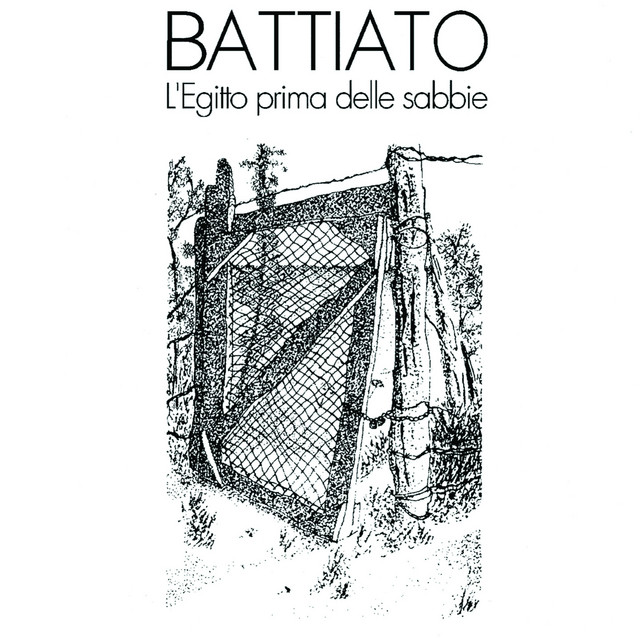
L’Egitto prima delle sabbie is the last album of Battiato’s experimental period and was released in 1978 on the Ricordi label. It's an instrumental work of extreme minimalism without the slightest trace of rock and featuring only two long tracks...


The title track is a piece for piano solo... Just one chord, a single short arpeggio repeated more and more times for almost fifteen minutes. It was a kind of research on the natural harmonic sounds generated by the first wave of notes played... It was awarded with the “Stockhausen Prize” but I fear that most of the progressive rock fans would find it boring to say the least...

The second track, “Sud Afternoon” is a piano duo composed by Battiato and performed by Antonio Ballista and Bruno Canino, two classical musicians. This composition is another piece of “contemporary classical minimalist avant-garde”, slightly more articulated than the previous one but in my opinion in the same bleak mood...

On the whole, an album that might be of some interest just for connoisseurs of contemporary classical avant-garde...

If you dare, listen to the complete album HERE

Franco Battiato: L’Egitto prima delle sabbie (1978). Other opinions:
David “Guldbamsen”: As a big fan of Franco Battiato and his ever changing sonic routes, this album completely threw me off balance. The man has always done things his own way, but the transition he made from his first four progressive rock albums to the minimalist approach found on subsequent albums made my head spin. I guess you could spot certain Stockhausen influences on an album like 'Clic', but they in no way prepared you for the white shimmering nothingness of this, his final minimalist installation, 'L'Egitto Prima Delle Sabbie'... (read the complete review HERE)


Friday, 9 December 2022

SEAS OF IRRATIONALITY

Clic is the fourth studio album by Franco Battiato and was released in 1974 on the Bla Bla label with a line up featuring, along with the Sicilian artist (piano, organ, VCS3, mandola, vocals), Gianni Mocchetti (guitar, bass), Gianfranco D’Adda (percussion), Juri Camisasca (vocal effects), Pietro Pizzamiglio (vocal effects) and the Quartetto Ensemble of Milan Conservatory directed by Luciano Bianco. The album is dedicated to Karlheinz Stockhausen and is the first of a series of works that many people find almost impossible listening to. On this album there’s no much room for rock and “to be progressive” here means most of all experimenting new sounds and effects. In this period Battiato became more and more involved in avant-garde and less and less interested in music business dynamics, the art cover by Mario Convertino reflects this minimalistic approach...


The opener “I cancelli della memoria” (The gates of the memory) is a piece with a mysterious, disquieting mood. It’s like a horror film soundtrack with sax lines appearing like a ghost before melting back into the mist and giving room to an interesting rhythm pattern...

Experimental sounds and reverse tapes introduce also the following “No U Turn”, the only track on this album featuring lyrics and a conventional vocal part. Here the artist depicts in some way his personal inner quest to knowledge and truth and his fight on the brink of madness against the haunting ghosts of anguish and fear... “To destroy old realities / I floated on seas of irrationality / I slept to not die / Throwing away my paper myths / On skies of schizophrenia...”. In my opinion this is the best track on the album and the closest one to the sound of Battiato’s previous works...


The third track, “Il mercato degli dei” (The god’s market), is a minimalist piece where synthesizer and piano arpeggios set an ethereal atmosphere, while the following “Rien ne va plus: andante” is just an experimental and almost self-ironic collage of classical music hints... Definitely unconventional but not completely convincing!

Another good piece is “Propriedad prohibida”, an interesting example of electronic music with a strong spacey flavour featuring strings and synthesizers while the last two tracks are frankly weak. “Nel cantiere di un’infanzia” (In the building site of a childhood), in my opinion, is just a clumsy mix of experimental sounds and Mediterranean melody and “Ethika fon ethika” is nothing more than a mix of scattered sounds put together with the collage technique...

On the whole, this is not an essential album, but it could be of some interest for Franco Battiato’s fans and experimental music lovers...

You can listen to the complete album HERE

 
Franco Battiato: Clic (1974). Other opinions:
Michael Berry: A dense ambient electronic album with some avant sections that hint broadly on where he would be heading in the years down the road. This album was the culmination of his early electronic period. The avant hints that were dropped in Sulle Corde di Aries are even more pronounced here, and possibly more fully realized. An incredible album. Not being particularly into the electronic side of prog I can't vouch for what Battiato did in comparison to others. In creativity or quality for that matter. All I know is what my ears tell me.. and they tell me that I love this album... (read the complete review HERE)


Thursday, 8 December 2022

ON MYTHICAL STRINGS

Franco Battiato started his career in the mid sixties as a beat singer. In the early seventies he turned to progressive and released some interesting albums as “Fetus” and “Pollution” then, with “Sulle corde di Aries” (On Aries’ strings), he began to turn from progressive to pure avant-garde. Nonetheless this album is absolutely worth listening to since here the experimental passages are well balanced with more melodic parts. The line-up features Franco Battiato (lead vocals, synthesizer VCS3, guitar, piano, calimba), Gianni Mocchetti (guitar, mandola, backing vocals) and Gianfranco D’Adda (percussion) plus many guests who helped enrich the sound.


The long opener “Sequenze e frequenze” (Sequences and frequencies) blends dark experimental sounds with oriental influences; hypnotic, unusual “filtered” vocals soar after more than two minutes and seem to be floating on a “flying musical carpet” while evoking memories from childhood... “In summer our teacher taught in her garden / I used to sit on a little wall looking towards the sea / Every now and again a ship passed by...”. Then the vocals give way to suggestive percussion patterns and to other experimental sounds. Quite interesting, even if for some this track could seem too long (sixteen minutes!) and in the end a little bit boring...

On the instrumental “Aries” you have more experimental sounds, percussions that seem to imitate a horse-ride and a jazzy sax outro. The atmosphere is ethereal and spacey. Well, Aries is the first sign of the zodiac and in some way it well represents this bold, futuristic track.


Next comes “Aria di rivoluzione” (Air of Revolution) which in my opinion is the best track on this album. Hidden and painful memories seem slowly coming afloat... “At that time in Europe there was another war / There were no songs but alarm hooters...”. Here Franco Battiato’s lead vocals in “Arab style” perfectly interact with the voice of Jutta Nienhaus (the singer of the German/Italian band Analogy) who recites some verses in German taken from “Genossen, wer von uns wäre nicht gegen den Krieg”, a poem by the German “Liedermacher” Wolf Biermann. The musical background is evocative... Policemen trained against the people are drowned in the crowd storming through the streets like a raging river... “My generation wants new ideals / I’ve already felt the revolution in the air / I’ve already heard who will be shot down...”.

The final track “Da Oriente ad Occidente” (From the East to the West) is like a musical journey from East to West, from Oriental influences to jazzy sounds... “Away from this darkness the future ripens / The sky is without clouds / Father please, let me set off...”.

You can listen to the complete album HERE 

From the book Rock Progressivo Italiano: an introduction to Italian Progressive Rock

Frano Battiato: Sulle corde di Aries (1973). Other opinions:
Jim Russell: All in all, the album has a very "holy" feel to it, a spiritual feel. It's like an ancient archeological find, a piece of art that is soothing and unsettling. It's about texture, ambiance, and mood... it is not about rock and roll songs. A masterpiece in my humble opinion... (read the complete review HERE)


Monday, 15 November 2021

A PLAYFUL GORILLA

Chester Gorilla took shape in Palermo, Sicily, in 2007. After many line up changes and an immature self-produced demo EP in 2011 entitled Solo guai, in 2019 the band recorded a good eponymous debut album that was released the following year on the independent label Vasto Records with a line up featuring Daniele Caviglia (guitar), Filippo “Phil” Caviglia (bass), Salvo Cheerio (trumpet, percussion) and Vincenzo Salerno (sax) plus the guests Cristian Manuk (flute), Alessio Masi (piano, synth) and Sergio Beercock (vocals, loop station). The overall sound is a nice mix of jazz-rock, funk and psychedelia with strong echoes of Italian seventies B-movies soundtracks while the artwork by Alba Scherma might recall Gong’s You...
 

The brilliant opener “Puippara” is a lively track that seems coming out from a car chase scene of an Italian poliziottesco film. There’s a good use of the flute while the frenzied rhythm and the nervous passages could recall bands such as Calibro 35. Next comes the dreamy “Shesone”, calmer and sprinkled with exotic flavours...
 
 
“Peter The Elephant”, features the guest Alessio Masi on piano and synth and starts by a calm piano passage and a bellowing sax, then the rhythm section comes in for a bold ride through the jungle on the back of an elephant in search for adventures while the following “Aripupollo Space” mixes jazz and psychedelia with funny, carefree inventiveness.
 
Chester Gorilla on stage, 2020
 
“Guacamole” blends pulsing bass lines and funky passages with darker, Mediterranean flavoured parts and a touch of mystery while the closer “The Heat”, featuring the guest Sergio Beercock (vocals, loop station), goes in a different direction trying to combine jazz and soul with soft disco atmospheres and smooth lounge music.
 
On the whole, a good work.
 
You can listen to the complete album HERE

More info:


Thursday, 1 July 2021

A SPACE HERO

In orbita is the sixth studio album by Conqueror, a Sicilian band whose roots date back to the nineties. It was released in 2019 on the independent label Ma.Ra.Cash Records with a renewed line up featuring Simona Rigano (keyboards, synth, lead vocals), Natale Russo (drums, percussion), Tino Nastasi (guitars) and Sofia Ferraro (sax, flute, EWI 5000) plus the guests Edoardo Ragunì (bass, backing vocals) and Giovanni Alibrandi (violin). It’s an excellent conceptual work inspired by the life of Russian space hero Yuri Alekseyevich Gagarin  (1934 – 1968) where the music and lyrics try to express emotions and feelings through a sort of empathy with the protagonist rather than just telling a story. The colourful art cover by Giusy Lo Conti in some way depicts the emotional content of the album...


The dreamy opener “Fino al limite” (To the limit) starts softly evoking beautiful landscapes where all the natural elements dance in symbiosis with colours and moving lights... The words and lyrics try to take us back in the childhood of the protagonist, born in the rural village of Klushino, in Smolensk Oblast, Russia. The child, curious and interested in everything, develops an almost transcendental fascination for flight and is determined to pursue his dreams, a bit like Jonathan Livingston, the seagull...

The tense “In cerca d’ali” (Looking for wings) tells of an episode from the protagonist childhood. The music and lyrics describe the evolutions of two planes, red stars falling from the stars avoiding the crash with an audacious combination of geometrical manoeuvres... In a cold winter night, two jet fighters of the Red Army are forced to make an emergency landing in the snow because of a mechanical breakdown. All night long the pilots wait for the rescuers without leaving the damaged air-crafts and the children of the village can admire their courage and tenacity. 


 The dynamic “Verso un nuovo mondo” (Towards a new world) is about the feelings and sensations that the protagonist experiences during his hard training for the space mission. The music alternates lively, almost funky passages with calm, dreamy sections evoking symphonies of colours and rains of sounds while heart and mind of the cosmonaut are focused on the goal of the mission...

Kedr” starts by a nice organ solo pattern, then the rhythm rises as the protagonist is going to board the space-craft. This piece depicts in music and words the emotions and feelings that the protagonist experiences before and during his space mission, the first space flight of the Vostok programme and the first human space flight in history. The title refers to the call sign used by Gagarin during the mission. The Vostok 3KA space capsule was launched from Baikonur Cosmodrome on April 12, 1961, with Soviet cosmonaut Yuri Gagarin aboard, from the space he can see that the the Earth is just a far, small blue planet and everything takes a different perspective... 


Yuri Gagarin 1961 (pic from Wikipedia)

Un disegno perfetto” (A perfect drawing) is a reflective track that deals with the effects of this extraordinary experience on protagonist. There’s a new awareness, a new maturity, the whole soul of the cosmonaut is transformed and he finds a new balance where serenity and troubles melt... Per aspera ad astra!

The title of the short instrumental “09.07 A.M.” refers to the departure time of the space mission. It’s a beautiful, classical inspired track that leads to the closer “Star On The Moon”. Despite the English title, the conclusive piece is mainly sung in Italian with backing vocals in English. It’s a light, melodic track that draws solar visions from the space, stars over a sailing moon lost in the sea of the universe in a never ending journey towards new worlds and dimensions...

On the whole, an interesting concept and a wonderful work!

You can listen to the complete album HERE

More info:


Wednesday, 24 February 2021

A THUNDERING SILENCE

 Quel che non dici is the first full length album by Sicilian band ArcaMiri and it was released in 2019 with a consolidated line up featuring Vincenzo Arisco (drums), Peppe Capodieci (bass), Simona Minniti (vocals, synthesizers) and Ivan Ricciardi (piano, synthesizers). It confirms all the good qualities of their previous debut EP, Contatto (2018), with an elegant mix of classical influences, avant-garde, jazz and progressive rock sprinkled with a touch of electronica and various Mediterranean flavours that could recall different bands and artists such as Opus Avantra, Matia Bazar or Franco Battiato...


The opener “L’adesso” (Right now) blends electronica and rock and every now and again could recall the clever early eighties synth pop of Matia Bazar. It’s a disquieting piece where the music and lyrics evoke the painful contrast between illusions and reality and the need to clash against the obstacles of life to understand where is the good and the evil...


The title track, “Quel che non dici” (What you don’t say), starts by a delicate piano passage and deals with the difficulty to express your inner feelings and the effort to hide your troubles from the eyes of the world. The music and lyrics here conjure up the image of a thundering silence that rages like a hurricane under your skin, echoing in the void and slowly killing you...


The dark “Inquietudo” (Restlessness) alternates narrative, theatrical vocals and high pitched, obliques melodies while the music and the poetical lyrics depict a path closed in a circle and a vortex of words, a mysterious shape wandering in a labyrinth of inner troubles and the silent, desperate screams of a woman searching for peace...

The bittersweet “Ballata (di una vecchia puttana)” (Ballad of an old whore) draws the portray of a woman hardened by a difficult life who doesn’t long for redemption but is tired to be judged by people and to get hurt by poisonous tongues and self-righteous looks...


“Piove” (It rains) starts with a nervous drum solo and blends frenzied passages and calmer, melancholic parts where the soaring, operatic vocals evoke a fall of painful memories and obscure desires...

The delicate, dreamy lieder “Dentro una goccia” (Inside a drop) closes the album describing a metaphorical journey inside a drop of dew falling down from the sky where you’re just waiting for a miracle, searching for your lost time, beyond tears and regrets, until the earth swallows your ethereal body...

On the whole, a very good album, challenging and full of nuances, but that needs more than a spin to be completely appreciated...

Have a try! You can listen to the complete album HERE

More info:
https://www.facebook.com/arcamiri/


Sunday, 16 December 2018

THE VOID AT THE END OF THE TUNNEL

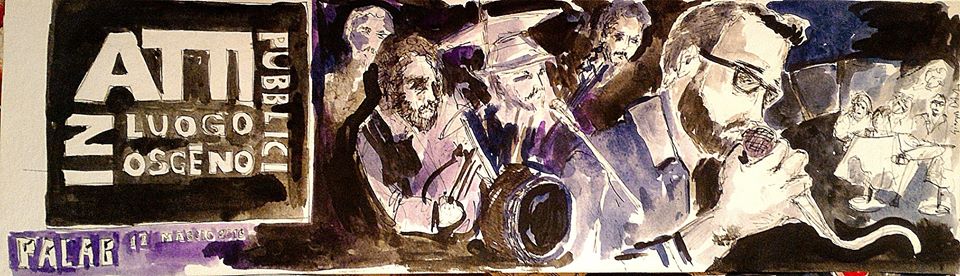
Atti Pubblici in Luogo Osceno came to life in 2014 in Bagheria, a little town in the province of Palermo, Sicily, on the initiative of Gioacchino D’Amico and Sergio Giuliana. After some personnel changes and a good live activity on the local scene where they played original stuff and some covers of bands such as Queen and Pink Floyd, in 2018 the band self-released an interesting debut album entitled In fondo vedo il nulla assoluto (At the bottom I see the absolute void) with a line up featuring Antonio Tralongo (vocals), Alessandro Siragusa (keyboards, vocals), Gioacchino D'Amico (guitar, vocals), Gabriele Lo Iacono (bass) and Giuseppe D'Amico (drums). In my opinion the hard work of the band to refine their original compositions paid off and the result is a nice mix of vintage sounds, hard rock and melody that is absolutely worth listening to. Although the sound quality might not be perfect it is better than that of many albums recorded in the seventies and the capacity to convey emotions of the musicians is apparent.


The opener “La boutique degli inermi” (The shop of the helpless people) is an introspective track about regret and lost chances. There’s a vein of melancholy in the surreal, dreamy atmosphere as music and words conjure up images of Christmas lights and old books while a pendulum clock beats the time swinging between boredom and agony. A bunch of doubts are your only company as you enter an old shop at the end of the road where a gipsy shows you all the time you lost looking through the window, in search for answers you never found… Standing still, looking at the bricks in the wall we are all the same, dummies and clones adrift on the ocean. At every step you can hear the sound of creaking wood follow the weightless, crumbling body of a lost fool dancing on the shores of Ys... 


The following “Salò” starts with a funky incipit, then in turns the music reminds me of Max Gazzè, Il Balletto di Bronzo and Deep Purple… It’s a sarcastic piece against consumerism and the false ethical values of an obscene world where it doesn’t matter if you steal or commit a crime provided that you do it with class. The title refers to Salò or the 120 Days of Sodom, a 1975 Italian-French horror art film directed by Pier Paolo Pasolini that is a loose adaptation of the novel The 120 Days of Sodom by the Marquis de Sade reset during WWII. The film explores the themes of political corruption, murder, abuse of power, sadism, perversion, sexuality and fascism and here the band express all their disdain for the lack of moral values in our society...


The bitter-sweet “Quando è già finito” (When it’s already over) is an impressionist piece drenched in melody and nostalgia where music and words have the colours of a Claude Monet’s tableau. It tells of the end of a romance... A girl has left Sicily and his sweetheart for the city of Bologna and the fogs of the Padan Plain...

Atti Pubblici in Luogo Osceno 2018

The long, complex “Venivo da sinistra” (I was coming from the left) ends the album blending hard rock, jazz rock and dreamy melodic passages. The caustic lyrics, interpreted with a strong theatrical approach, tell of defeatism and indifference in of a world on the wane, of crazy dreams melting at dawn and of the loneliness and pain of a man going in the wrong direction who feels lost in a world he can’t accept...

On the whole, a very promising debut work!

You can listen to the complete album HERE

More info:

Saturday, 20 October 2018

FROM SICILY...

ArcaMiri come from Syracuse, Sicily and took shape in 2017 when four talented musicians met to play original compositions with the aim to experiment and find a personal sound. The line up features Vincenzo Arisco (drums), Peppe Capodieci (bass), Simona Minniti (vocals) and Ivan Ricciardi (piano, synthesizers). In 2018 they self-released an interesting EP entitled Contatto (Contact) containing four tracks recorded between December 2017 and May 2018 where they blend classical music, jazz and progressive rock with various exotic musical spices. Ethereal atmospheres, changes in rhythm and mood, poetical lyrics, soaring operatic vocals… If you like bands such as Opus Avantra I think you should listen to them!


The opener “Quasi alba” (Almost dawn) is a kind of disquieting lullaby that starts with far echoes of tango and a melancholic mood. It tells in music and lyrics of a tense silence where haunting nightmares creep in asking for a place in your soul and in your body. There’s a little boat lost on a threatening sea, the people on board feel helpless and fragile like a thin piece of paper that is going to be torn...

“La notte e la luna” (The night and the moon) tells about a sad, unfortunate love where desire and pain seem almost to play to hide and seek with destiny. The pace is slow, the atmosphere dark, the voice of Simona Minniti filled with emotion...


“L’anno dei sogni” (The year of dreams) is a nervous track about the loss of innocence that blends hints of funky with opera. Music and words evoke disquieting images, like the innocent blood on the skin of a little girl and a haunting, treacherous sense of void that hits you in the back taking away a part of your soul...

The closer “In acido” (In acid) tells of the loss of identity in a troubled relationship. The music evokes a kind of game of lights and shadows as reality and thoughts melt away...

On the whole, a very promising debut!

You can listen to the complete Ep HERE


Friday, 19 June 2015

UNDER THE RAIN

Trasparenze is the fifth studio album by Malibran, a band from Catania whose roots date back to 1987. It was released in 2009 on the independent label Electromantic, more than seven years after its predecessor Oltre l'ignoto. Although it was originally conceived as a solo project of the leader and multi-instrumentalist Giuseppe Scaravilli, later other members of the band joined him during the recording sessions and eventually this excellent work was released under the name Malibran with a line up featuring Giuseppe Scaravilli (vocals, acoustic and electric guitar, flute, bass, keyboards), Jerry Litrico (guitar) and Alessio Scaravilli (drums) plus the guests Giancarlo Cutuli (sax) and Toni Granata (violin). Of course, here composer and lyricist Giuseppe Scaravilli does the lion's share playing almost all the instruments but the result is in perfect continuity with the band sound. In the booklet you can find extended liner notes that explain the genesis of each track while the art cover is taken from a painting by Karl Friedrich Schinkel that in some way describes the spirit of this work...


The opener is the title track, "Trasparenze" (Transparencies), a complex suite with many changes in rhythm and mood featuring some passages that could recall Genesis or Jethro Tull. It's about the passing of time... All along your life there's something or someone that attracts you and shows you the way you have to follow with its perfumes and its fire. You have to go on and on as your age flows away like a short poem, between dreams and reality, led by your will and by the flames of that fire...

Next comes the dreamy "In un attimo" (In a while). It starts with strummed guitar and flute, then the music and lyrics conjure up a long awaited, timeless moment of peace. You have in front of you a white canvas that your are going to fill with the colours of your dreams... You are painting a magic landscape and your soul is flying over there. Your troubles are left behind and you can smile, forgetting for a moment all the problems of everyday life, your mind is already over there...


"Vento d'Oriente" (Wind from the East) features a mysterious, exotic flavour. Heavy electric guitar riffs are mixed with Mediterranean influences while the music and lyrics evoke distant deserts and ancient sands, lost identities and empty realities. Listen to the voice of the wind blowing from the East, it carries echoes of ancient songs and whispers mysterious charms...

"Presagio" (Omen) alternates calm, pastoral sections to heavy riffs and Latin rock passages. It tells of obscure presages looming on the horizon like the thundering sound of the rapids ahead while you are swimming on the calm waters of a river, cradled by the current. Well, you've better keep calm and fight against all the adversities of life without fear...


"Pioggia di maggio" (Rain of May) is a beautiful, dreamy instrumental track full of soaring, delicate melodies. It leads to "La marea" (The tide) that tells in music and words of the contrast between the need to go away searching for a better way of life and the responsibilities that prevent you from leaving, keeping you tightly bound to your routine. You know you have to stay but you feel a strange emptiness growing inside you, maybe one day or another you'll turn your glance back and you'll start running after an idea, following dreams and ideals, drifting with the tide towards new horizons...

"Nel Ricordo" (In the memory) is about the power of fate. Your future turns around you like a dark shadow from whom you can't escape, you'll soon forget who you are because you're already changing and moving forward, you can't help it! The days and the nights you spent are like circles in the water that soon will fade away, the past is going to melt in your memory, you can't cheat on destiny...


"Volo Magico" (Magic flight) is a short instrumental track that conveys a strange sense of mystery. You can hear the sound of the bumblebees around you as you're flying from flower to flower under the charm of exotic perfumes and colourful landscapes... It leads to the nocturnal atmospheres of "Promesse vane" (Vain promises), a piece about a man who feels like an eternal boy and finds difficult to accept his everyday life and the burden of time passing by. Where are the promises of his childhood, what is left of his old dreams? He's burning out and nothing but his fantasy and imagination can set him free from the metaphorical chains of reality and make him happy, at least for a while...

The short, dreamy "Gioco di specchi" (Game of mirrors) is a nice instrumental track that introduces the wonderful suite that closes the album, "Pensieri fragili" (Fragile thoughts), a long, complex piece that every now and again recalls Arti & Mestieri and begins by the sound of a pouring rain... Here the music and lyrics take you back in time to World War I, in a trench along the front between the Kingdom of Italy and the Austro-Hungarian Empire. Under the rain the thoughts of a young infantry soldier unfurl while the water washes away a desperate night of waiting. Around the soldier there is nothing but mud and fog but he dreams of enchanted valleys and smiling faces that now seem just faded memories... A thousands eyes observe the human fragility from the sky, the soldier feels that the real enemy is inside him, he wants to give up not because of cowardice but because he feels that this war is not his own business. He doesn't care about honour and glory and in the fog he gets stealthily out of his shelter and runs for his life, disappearing in the rain...

On the whole, I think that this is a wonderful album without weak moments that will not disappoint Italianprog fans...

Malibran: Trasparenze (2009). Other opinions:
Chris "Seventhsojourn": Trasparenze is a long album that clocks in at 78-minutes, so you get your money's worth. There's not even much filler on it, with maybe just a couple of slightly weaker songs. My one criticism is that the album is a bit light on keyboards, but the loads of great flute you usually get with Malibran offset this... (read the complete review HERE)

More info:

Wednesday, 17 June 2015

MEMORY TRICKS

Hailing from Santa Teresa di Riva, a small town in the province of Messina, Sicily, Conqueror have been part of the Italian prog scene for more than twenty years and Stems is their fifth full length studio album. It was released in 2014 on the independent label Ma.Ra.Cash Records, four years after its predecessor Madame Zelle, with a renewed line up featuring Simona Rigano (keyboards, lead vocals), Natale Russo (drums), Ture Pagano (guitars) and Peppe Papa (bass). Sabrina Rigano left the band in 2010 and without her flute and sax contributes the overall sound of the band is more keyboard and guitar driven than in the past but still extremely crisp and convincing. According to the band's website, on this album you can find eight tracks with a common thread, eight poetical frescoes of daily life memories where the passing of time changes the perception of reality. Anyway, each piece takes on its own very distinct personality and in the booklet you can find a photograph associated to every track that in some way helps to describe the mood of the music and lyrics...


The beautiful opener "Gina" is a long, complex track that evokes memories of warm hugs lingering in the night while time is nothing but a blurred concept. Who is Gina? There's no clue to know it, she might be an elderly woman or a little child... The music starts softly then a drum roll leads to darker passages and a disquieting marching beat seems to evoke the ghosts of an impending tragedy... What is left of the mysterious Gina is just the souvenir of a crown of coffee-beans and a smile, the perfume of a lost happiness, the sound of words that are still able to stir your imagination, a tenderness that stems from the soul and still shines in the memory...

The reflective, dreamy "Di notte" (At night) conjures up a melancholic quest in the dark for the signs of the days that are gone, a search for soft whispered words, breaths and sounds drowned into the light of a reality that leaves no room for memories and regrets and where your thoughts get lost in the perpetual motion of the daily grind...


Next comes the ethereal "False idee" (False ideas) that conjures up a mysterious atmosphere. After a walk under a dark moon, a strummed acoustic guitar passage evokes never forgotten silences that come back echoing around you until the first rays of the morning sun... When the sun will rise you'll have to make up your mind to see a new light and regenerate your faded energies, trampled by false ideas. In your dreams white butterflies are flying free among orchid petals. It might be a good omen...

On the following "Un'altra realtà" (Another reality) the soaring vocals of Simona Rigano interpret the thoughts of a woman that closes her eyes and pretends that she doesn't see what's happening around her. She dreams of another reality where good prevails over evil... Call it hypocrisy or just fragility or weakness but she wears a metaphorical mask and hides her feelings, biding her time to find another way of living...

Conqueror on stage 2014

The melancholic "Sole al buio" (Alone in the dark) features some bluesy passages and tells of the contrast between the promises of the childhood and the choices that you have to do when growing up. Now all the illusions and the promises of the past are gone, abandoned like old pictures in a box, left alone in the dark... But you can't forget that past and sooner or later you'll pick those pictures out of the box to look at them under a new light.

"C'est la vie" is a lively track that recalls PFM and tries to depict in music and lyrics the frenzied rhythm of progress in a modern age where you can never stop and look behind. No rules to follow, no time to breathe, no room for reflection, everyone is always in hurry and reason sometimes is left behind while the world runs like hell in a direction that we can't even imagine... Stop to think, at least for a while, soon the celebration of modern life will start again!


The calm, evocative "Sigurtà" depicts in music and lyrics the magnificent landscape of a natural park and the emotions provoked by the colours of its plants and flowers. You can walk along the paths of this enchanted place following the timeless ghosts of Romeo and Juliet... By the way, the title refers to, Parco Giardino Sigurtà, a beautiful natural oasis located in Valeggio sul Mincio, near Verona, the home city of the famous lovers.

The closer "Echi di verità" (Echoes of truth) is another great track where the music and lyrics depict in a poetical way curious lies and melancholic half truths, deceiving mechanisms that make you lose the sense of reality by deforming feelings, images, sounds and smells... How can you face such a labyrinth of mirrors and escape from the maze of your false perceptions? How can you decide and choose? How can you understand what is really important in your life as times goes by? Well, the answer is up to you...

On the whole, a wonderful album that marks the maturity of this band.


More info