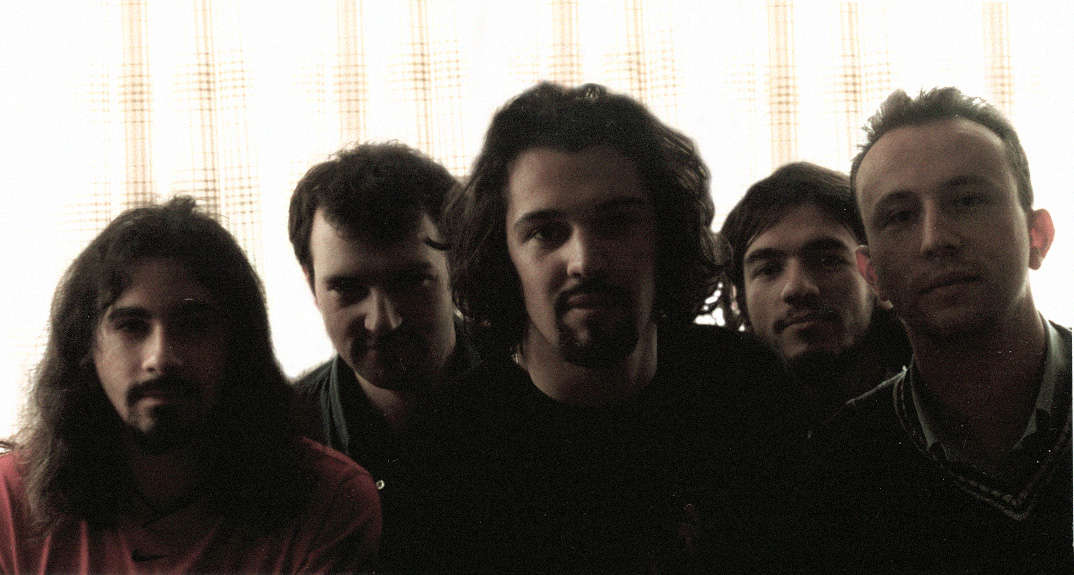
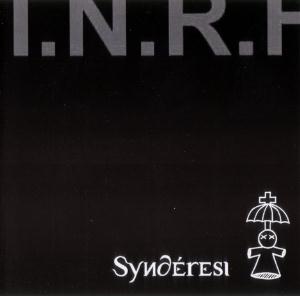
Syndéresi come from the province of Treviso and were formed in the late nineties. The name of the band means Synderesis, a philosophical term that defines the natural capacity or disposition of the practical reason to apprehend intuitively the universal first principles of human action. After some line up changes, in 2001 they started to work on a debut album, a conceptual work inspired by the gospels with a line up featuring Ivan Capraro (vocals, percussion), Ronny Tittoto (guitars, vocals), Giovanni Panno (piano, keyboards, flute), Gianluca Lombardi (bass) and Alberto Bazzaco (drums). In 2003 they finally released a self produced debut album titled I.N.R.H. that, according to the band, was meant just as a demo. Unluckily they didn’t find a deal with any label and soon after the release of the “demo” they split up. It’s a real pity, because I.N.R.H. is a very promising work.
Syndéresi
The acronym I.N.R.I. (Iesus Nazarenus, Rex Iudaeorum) represents the Latin inscription which in English reads as “Jesus the Nazarene, King of the Jews” that was put on Christ’s cross and the album was titled I.N.R.H. (Iesus Nazarenus, Rex Hominum) to underline the human side of Jesus. However, Syndéresi’s album has nothing to do with woks such as Jesus Christ Superstar, it was not conceived as a lecture about the Gospels or to reinterpret them or to exalt religion. The lyrics were written by Alberto Bazzaco and were inspired by the gospels (canonical and apocryphal) but they deal in a poetical way with issues such as fate, omens, the relationship between men and time, feelings. The music recalls the Italian prog masters of the seventies and is built upon the lyrics adding colorful, evocative touches to the concept.
The opener “Annunciazione” (Annunciation) is a kind of disquieting, psychedelic dream where the meeting between the archangel Gabriel and the Virgin Mary provokes an emotional vortex. There’s no happiness, the atmosphere is dark and some passages in the central section recall Il Balletto di Bronzo’s “Ys”. Mary sees in a play of shadows the reclined dying face of Jesus and the Annunciation here becomes almost an ominous presage for the future of her son.
“Natività” (Nativity) features a mysterious atmopshere and some Oriental flavours. This track was inspired by a scene narrated in the apocryphal Gospel of James. As Joseph goes out to look for a midwife to help his young bride to give birth to Jesus, Time suddenly stops. Joseph invokes God asking him to let Time flow again... “He looks astounded up to the sky / Please, let the vertex unbind the hourglass from its stagnation...”.
“Deserto” (Desert) is a nice, ironic track inspired by the meeting between Jesus and Satan in the desert. The rhythm is slow, the sun shines on the dunes, the musical colours are evocative and full of nuances. The devil is tempting Jesus with false promises but he replies that it would be easier tempting him elsewhere, not in a desert where the illusions of the world are covered by the sand... “Come back when my feet will be washed by clear waters / Bring with you wider fishnets...”. A mocking nursery rhyme sung by some children concludes the piece.
“Il discorso della montagna” (Sermon on the mount) is divided in two parts. The first part is an instrumental introduction featuring a delicate, dreamy atmosphere, then the rhythm section and the guitar come in adding new colours. This piece was inspired by the Sermon on the Mount, one of the most widely quoted elements of the canonical Gospels but it’s prevalently instrumental. “Dig an abyss of want and set you foundation in it...”.
“La parabola del seminatore” (The parable of the sower) is a particular acoustic track settled on a street and according to the band they played it as buskers to set the right atmosphere. It was inspired by the Parable of the Sower and in some way tells about another presage. The last part features a narrative vocal part taken from the Gospel of St. Mark... “The secret of the kingdom of God has been given to you. But to those on the outside everything is said in parables so that, they may be ever seeing but never perceiving, and ever hearing but never understanding; otherwise they might turn and be forgiven!” (Mark 4, 10-12).
“Maddalena” (Magdalene) is a delicate acoustic ballad inspired by the character of St. Mary Magdalene. The mood is romantic, the lyrics are hermetic... The memory of a kiss comes to mind in a stormy night as a vortex! The excellent last track “Ultima cena” (Last supper) recalls BMS and was inspired by the Last Supper, the final meal that Jesus shared with his apostles before his crucifixion. A very good conclusion for an interesting work. Of course, the production is not perfect and there are many ingenuities but the overall result is not bad at all. The album is available in free legal download, so have a try and judge by yourselves. Click HERE
Synderesi: I.N.R.H. (2003). Other opinions:
Jim Russell: There is a definite avant-garde spirit to what the musicians consider a symphonic prog album and I believe that whatever they considered unfinished in the production adds to a somewhat mysterious, unsettling, and pleasantly disorienting haze... (Read the complete reviewHERE)
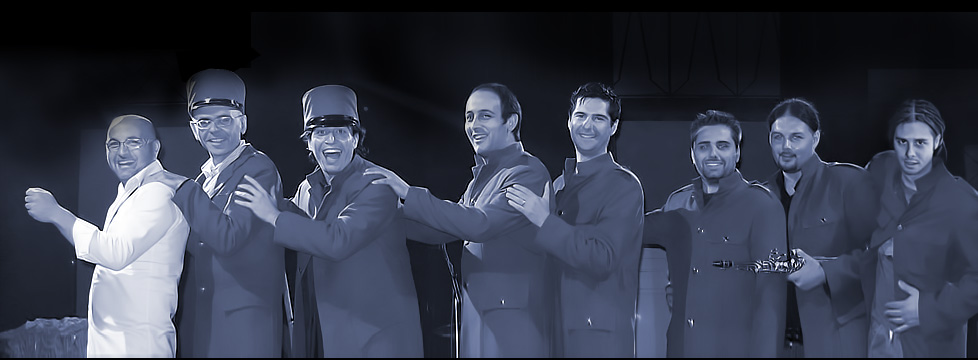
Outopsya began life in Trento in 2003 on the initiative of Luca Vianini and Evan Mazzucchi and other musicians helped them along the years. The name of the band is an acronym for OUT Of PSYchical Activity and the aim of the musicians involved in this project is to blend jazz, classical music, metal and progressive rock with electronic sounds.
Outopsya
After a debut album titled “Sum” (Videoradio, 2009), in 2011 they released a double album on the independent label Lizard Records, “Fake”, a complex work that was conceived as a soundtrack for an old American silent horror film directed in 1925 by Rupert Julian, The Phantom of the Opera, based on a famous novel by Gaston Leroux and starring, among others, Lon Chaney. On account of copyright issues, the band couldn’t release the album with a packaging featuring a DVD with the film to combine music and images, so the they turned it into something different, adding some vocal parts with English lyrics to make it more acceptable as an autonomous work.
Outopsya’s current line up features only Luca Vianini (guitars, vocals, synthesizers, drums) who wrote the music and lyrics and Evan Mazzucchi (bass, cello) who took charge of the art-work and design: the only “guest musician” here is a computer. According to an interview with the duo, they chose the title “Fake” to underline the dichotomy between what is false and what is true in the real life. The falsity here is evoked by the electronic sounds of the computers and contrasts with the sounds of the real instruments. The album was conceived as a single long track of more than 90 minutes but to be released on CD it had to be split in two parts. The two parts are characterized by two different colours, violet for the CD1, the most challenging, experimental one and black for CD2 featuring more accessible passages.
To be honest, I have to say that without the images some passages lose their evocative strength and risk to seem redundant, boring and to dilute the many brilliant ideas that you can find in this work. Moreover there are no liner notes and the booklet doesn’t contain the lyrics (that are almost incomprehensible since the vocal parts are frequently filtered through sound effects und used as an instrument). What to do then? Well, I’ve found the film on Youtube and I watched it with the music of this album in the background. In this way even the most experimental parts make sense. It did work and I enjoyed both the film and the music!
Notturno Concertante began life in Benevento in the eighties on the initiative of Lucio Lazzaruolo and Raffaele Villanova. Their debut album, The Hiding Place, was released in 1989, influenced by bands such as Genesis and Marillion. It was followed by Erewhon (1993), News From Nowhere (1994) and The Glass Tear (1994). After a long hiatus and some line up changes, in 2002 they released Riscrivere il passato (Re-writing the past) and after another long period and many years of work, in 2012 they finally released a new album, Canzoni allo specchio (Songs in the mirror), in my opinion their best so far. The line up on their last work features Lucio Lazzaruolo (classical guitar, keyboards), Raffaele Villanova (guitars, vocals), Giuseppe Relmi (lead vocals), Carmine Marra (sax, clarinet, whistles), Carmine Meluccio (violin), Gabriele Moscaritolo (accordion), Antonio D’Alessio (bass), Giuseppe D’Alessio (bass) and Simone Pizza (drums).
Notturno Concertante
The overall sound of the band is more original, personal if compared with the neo-prog of their early works and features many Mediterranean colours and psychedelic touches. The packaging is very rich and features the art-work of Fabio Mingarelli a.k.a. Ming, a booklet with the lyrics and the liner notes written by the Italian critic Donato Zoppo (with an English translation) and many pictures.
The opener “Ahmed l’ambulante” (Ahmed the hawker) is a kind of acoustic psychedelic trip in a cold winter night, a bad trip. It was inspired by a poem by Stefano Benni describing in a surreal way the death of an African hawker, a “vu cumprà”. It happened in the middle of the night under a desert arcade in an Italian city when a bunch of hooligans smashed his merchandise and hit him in the head with a stick, just for fun. Ahmed died but the goddess of the night came down to take his spirit back home... “Ashiwa, the goddess of the night came to set me free / She kissed my temples and healed my wounds / They didn’t see her / I didn’t die in a canvas bag but on a big pyre of ebony in the heart of the forest / And my people sung for forty nights...”. This is a really good track but Notturno Concertante were not the first band who interpreted Stefano Benni’s verses: in 1994 the Modena City Ramblers recorded another excellent song inspired by this poem on their debut album Riportando tutto a casa.
Next comes “Young Man Gone West”, more relaxed and lighter. It’s an instrumental track featuring violin and whistles in the forefront that drives you from East to West in a musical journey full of colourful nuances. According to the liner notes, this piece is dedicated to five young Kurdish migrants who died during their journey to Western Europe and whose corpses were found near Grottaminarda, not far from Naples. It leads to the dreamy, melodic “Come il vento” (Like the wind) that was inspired by a reflection about the charming, seductive power of words. The lyrics describe the feelings of a man who can hear the words of his lover echoing in his head in a starry night. The words are like a raging river that could submerge him... “Speak to me / Whisper to me / Mumble in my ear / Like the wind...”.
“Le anime belle” (The beautiful souls) is another beautiful, dreamy ballad. It’s a piece dedicated to all the daydreamers who keep on fighting against the windmills in name of their ideals. “The daydreamers are volunteers in a war that they want to lose...”. According to the liner notes this song was written to honour the memory of the late Antonio D’Alessio, bassist of the band who died in 2008.
“On Growing Older” is a short acoustic instrumental track built upon a nice guitar arpeggio. It leads to “The Price Of Experience”, a piece sung in English that recalls the neo-prog sound of the early works of the band (you can find a first version of this song on the album The Glass Tear from 1994). The lyrics evoke hopes sacrificed to the needs of the daily life... “All at once everything seemed to loose its magic and everything was so hard to bear / Someone said this is the price of experience, but I felt like I just had enough / When did I become another house with no door? / When every distance seemed to break my heart...”.
“Lei vede rosso” (She sees red) is a melancholic track featuring a nice sax work. The lyrics describe a woman on the verge of madness, everybody knows her but how can people really understand what’s going on in her mind? She keeps on staring at the washing-machine and can’t see nothing but blood, the blood of her lover who died in a car accident... “A veil falls behind her eyes / Your world becomes completely red...”.
“La milonga di Milingo” (Milingo’s milonga) is a nice instrumental featuring warm, sensual Latin American influences. The title is a kind a “calambour” (a pun) that combines the words Milonga (a South American dance) and Milingo, a criticized former Roman Catholic archbishop. It leads to another track full of sensuality, introduced by a saxophone solo, “Canzone allo specchio” (Song in the mirror). It’s a love song that starts from an image in the mirror which push a man to reflect about his errors... “You know there is nothing to say / Silence speaks for us today / I just remember that I was lost / And you found me...”. The romantic, short instrumental for classical guitar and piano “Ark En Ciel” (Rainbow) concludes the album
On the whole “Canzoni allo specchio” is a very nice work. I suggest to listen to it in streaming from the official website... Judge by yourselves!
Something changed at the beginning of the nineties and interest for this genre of committed and complex music seemed to emerge again. Since the interest of collectors had increased, some independent labels as Mellow Records and Vinyl Magic were set up and re-released old out of print albums and later also tried to promote some new bands. On the wings of this new and growing interest even some bands that during the seventies had no chance to release an album, as Il Castello di Atlante or Consorzio Acqua Potabile, were able to restart, record their music properly and finally release their debut works. Of course, they didn’t it for the money, what kept them playing was mainly friendship and passion for music. Paolo Ferrarotti, drummer of Il Castello di Atlante: - Il Castello di Atlante is not a band! It’s the virtual place where five young men met way back in 1974 and where they have been growing up till now. Il Castello is the place where we can find peace and stillness, ‘cause we’re friends, nothing else, simply real friends. What binds us is friendship not the music, this is why our line-up has had few changes over the years...[1].
Il Castello di Atlante, 2022
There were some new bands, as Nuova Era, Calliope, Finisterre and Germinale, which tried to deal with the themes and the sonorities of the progressive era with an up to date touch, while some “historic” bands brushed off the rust from their glorious past. Enrico Perrucci, keyboardist of Calliope: - We are fans of the more “traditional” prog but we also like other groups of the so-called New Prog scene of the nineties... We write and arrange our songs as a sequence of different scenes... In this way we use the song duration to form a continuously-evolving musical narration. So we have melodic moments, sometimes minimalist, others more powerful or symphonic featuring choirs, strings, orchestral sounds but we also have rock moments, more rhythmic and hard, with guitars, Hammond and strong rhythmic passages. We love to use as many colours as possible, in this way we hope to capture the interest of the people listening to us but we also enjoy ourselves, or at least we try. As to our lyrics, we don’t draw our inspiration from fantasy, or magicians or goblins. We usually talk about social issues or everyday situations... The songs are a sum of the souls of the musicians who contributed to their writing and execution, so there are moments when the atmosphere and the sounds are close to the 70s, but we do not feel it as a chain. It's a choice we make, where we like, without foreclosing the possibility of using more modern colours and textures[2]. Alessandro Toniolo, flutist and saxophonist of Germinale: - We have always been prog lovers because of its rhythmic and harmonic freedom, because of its violence and sweetness freely blended together. But when this freedom becomes a cliché it’s better to give up... So, for us it’s a natural thing to leave behind the prog form if it’s seen just as a set of rules[3].
Enrico Perrucci
In 1994 I remember going to a wonderful performance of Le Orme promoting their album “Antologia 1970 – 1980”. The theatre was crowded and the public enthusiastic. After three hours of music the members of the band were happily signing autographs and explaining to their fans that they never meant to stop, that they have always wanted to go on playing their music but for many years they couldn’t find any attention from media, labels and managers... Progressive rock suddenly seemed to be born again. I still remember the “Testaccio Village Progressive Festival” in Rome in 1996 with Le Orme, BMS, Osanna, Metamorfosi, Il Balletto di Bronzo and an interesting new band called Divae. Luckily many other prog festivals and concerts have followed in Italy since then, with good success. Andrea Pavoni, keyboardist of Greenwall: - The musical scene in Rome and in Italy in general, seemed to be more stimulating in the last part of the nineties, when Greenwall were formed. There was the opportunity to play live and there was a community of people who were deeply interested in what happened in the “progressive rock” genre in general, who followed the concerts and made comments, on the internet or even live, and there was a network of people we could interact with[4].
Andrea Pavoni
Well, new bands and old “dinosaurs” are still able to release excellent albums, blending new sounds and fresh inspirations with the echoes from the past, and they’re still able to communicate emotions performing concerts with high quality standards. Many historic bands recently re-formed, as Raccomandata con Ricevuta di Ritorno, Alphataurus, Locanda delle Fate, Latte Miele, The Trip, Picchio dal Pozzo... Often behind these reunions there’s nothing but friendship, passion and love for music. Luciano Regoli, singer and guitarist of Raccomandata con Ricevuta di Ritorno, Il Ritratto di Dorian Gray, Samadhi and DGM: - In winter 2008, on the wave of a new blossoming of progressive bands, both in Italy and abroad, I got the idea to reform the old Raccomandata con Ricevuta di Ritorno, also encouraged by friends. I started to make phone calls and I managed to find, after a complete black out of 36 years, all the members of my old beloved band. I was so excited at the idea that one evening we met together for dinner and after so many years we felt as if time had never passed by. Those five boys were still friends. Time had changed life styles and habits but we still like each other. To make my project easier I had already written all the tracks for the future album since I understood that the others couldn’t write anything for obvious reasons as family and work. I did my best to put together the old band but eventually I had to give up. It was in that moment that Matthias Scheller of BTF gave me credit pushing me to go on with the old members that could collaborate as Roberto Gardin, Nanni Civitenga and Walter Martino who had been the drummer of the band for a short period. For the rest we got help from colleagues who had played in other old progressive bands from Rome and Naples in the early seventies. It has been a journey through time, dangerous and tiring but full of professional and human rewards [5].
Pietro Pellegrini, keyboardist of Alphataurus: - The Energy comes from the will to play together still and the challenge is to try to keep that word “progressive” relevant today... For sure we have a “dream”: a new record and, why not, a lot of concerts; the positive approval of people listening to our music is really important for us and we are mainly looking to give everyone the same feelings we gave about 40 years ago!! It’s a dream, we are aware of that but it’s not a forbidden dream, we are following our journey and we will see... We are not pretending to be what we were or trying to do things that we did when we were eighteen years old. We only want to transmit our joy in playing the music we like and we want to share these moments with all the folks that want to listen to our music and we hope that there will be many... And we hope that all the people who don’t agree won’t be angry with us: we can’t satisfy everybody [6]. Furio Chirico, drummer of The Trip and Arti e Mestieri: - There were many requests from friends, some of whom are now our collaborators, which came from Facebook. But the story starts from far away, as far as me and my personal manager are concerned, there was a great desire to give young generations the chance to hear the music of The Trip, especially abroad, in Japan, USA, etc. This is now possible thanks to our Italian management, their collaborators and international promoters. Then we are willing to meet again, not only for the band reunion but also to produce new ideas and projects [7]. Paolo Griguolo, guitarist of Picchio dal Pozzo: - Well, we could say we’re slowly waking up after a long sleep...[8].
Nowadays, Italian Progressive Rock is not a mass, generational phenomenon but diehard fans all around the country seem to be numerous and able to keep it alive. It’s almost impossible for an artist to earn a living out of progressive rock, so many musicians have another “daily” job and album releases are less frequent. Paolo Ferrarotti: - We aren’t professional musicians, the only musician is Roberto who plays in a dance orchestra (sigh!!) and is the owner of a small recording studio. Aldo, Massimo, Dino and I…. are…we are, listen… are you ready for a surprise? We are bank managers!!! You know the ones who are always in a jacket and tie, always serious, always connected to their offices? This is us! But, once a week, we change into a prog band… This for the last thirty-six years. Few colleagues of ours know we’re a prog band who go around the world playing our own music. I remember once I was in Verona, where there is the main branch of my bank, with a colleague of mine, while we were waiting for a meeting we went into a shop, it was Fnac, I found in the Italian CD section our album “L’ippogrifo”, - “This is mine”, I said. – “Yours? What do you mean?”, he asked. – “I recorded this CD”, I replied. – “Ah, ah, ah!”, he laughed loudly. I bought the CD (true!!), I opened it and I showed him the inside pics… He was stunned![9].
Luckily there are no more riots at the concerts or attacks against the musicians and this is a good point in comparison with the seventies, with a very few exceptions. Walter Pini: - Unfortunately, we had some trouble with politics as well. They couldn’t have been more unjust with us. Once in Florence we couldn’t even play because some people accused us of being a fascist band! For me the people who prevent the musicians from playing on account of politics are more fascist than the musicians, whatever the political idea of the musicians might be... but we as Nuova Era have never practised politics! In the band there were those who sympathized with the right wing and those who, like Alex, came out of extreme left circles.Now I’m completely apolitical as a person but the band has always been so! We played at some Feste dell’Unità (meetings organized by the Italian Communist Party), we played at gigs organized by Democrazia Proletaria (a party of the extreme left), at gigs organized by the right wing and at gigs organized by the Democrazia Cristiana (the Christian Democratic Party). We wanted nothing but to play... Prog, Yes! Politics, No! [10]. Well, today prog concerts are not as crowded as in the seventies but there’s still a lot of creativity and vitality. Beppe Crovella: - Now, also for many historical reasons, there’s more disillusion and less enthusiasm, and, above all, you have less the idea of a cultural movement. There’s less collective attendance and in comparison with the past there’s more dispersion and a kind of isolation. Nevertheless there’s still a continuous creativity. This effective, visible base is looking confidently into the future. In my opinion there’s a great vitality and many things that are still missing are just waiting to blossom again. Today it’s simpler because there are more ways and means to communicate than in the past but on the other hand there’s an enormous risk of dispersion[11].
Nicola Randone, singer and multi-instrumentalist of Randone: - The 70's were a great era for music, not only for prog but also for many other genres. The problem of prog today, and the difference between the bands of the seventies and recent ones, is that many bands tend to “copy” the past using the same sounds, often even the same already exploited rhythmic patterns. So many Italian prog bands seem to be just the photocopy of this or that, some bands even borrow the name of the group from the most important songs of that era. All this continual digging in the past leads to a decay of the genre that seems to have nothing more to say when, on the contrary, by its very definition, progressive should have no “stylistic” limits for its intrinsic ability to adapt to ever new languages: let’s take, for example, Soft Machine, Area, King Crimson, Genesis, Pink Floyd... There is a great difference between these groups and yet it is always progressive. I’d like us in Italy to dare a little more, let’s take international examples such as Spock’s Beard, and their latest album “X”, or the latest Porcupine Tree, the vein of prog metal with Dream Theater, Fates Warning and Tool at the forefront... Let’s take the latest work of Muse and one of my favourite Italian artists, Franco Battiato, who perhaps do not even know they play prog. Well, the success of all these artists proves that prog is not limited to the seventies but that it can evolve into modernity. Here I can already hear the first objections, that in Italy it is already difficult play classic prog, if then you modernize it you are bound to go broke. I would not deny this reality, and I am the first to suffer its consequences, however, I believe that if the press and the promoters of concerts in Italy stopped to worshipping and pushing the same old things like decrepit old men locked up in their ancient little world, well, the new recruits could also hope for a bit of attention in this beloved / hated world of prog[12].
Anyway today Italian progressive rock is not a “nostalgia” phenomenon. Of course, there are also many tribute bands and cover bands, but most of the new bands are just trying to express their passion for music, even when drawing from past models and sonorities. Michele Epifani, keyboardist of Areknamés: - We like what we do and we firmly believe that, although some stylistic choices may seem out of fashion the substance is always and only what you have to say. And it’s only by choosing the best way to express what you have to say that you are free[13]. Elisa Montaldo, keyboardist of Il Tempio delle Clessidre: - The music we propose is new and fresh even if we know that it’s not so innovative, but this is a choice: one of our aims is to recreate the sounds and atmospheres of ‘70’s progressive rock; nowadays it’s hard to create something completely new in progressive rock, because the music of ’70s has a great influence on this kind of artistic expression, so we wanted to re-create some typical ’70 sound even if it could be seen as a lack of originality. But our music was born spontaneously and without premeditation, we play what we like in the way we like. Obviously, there’s a precise idea we want to express and if you listen to the sounds, the atmospheres and every particular element you can find several musical influences: that’s our music that grew up under our eyes (and ears) without knowing where it would have taken us![14]
Elisa Montaldo 2015
Today there are many bands that take inspiration from the past but blend progressive with heavy metal or other music genres. So, there are bands that are influenced by P.F.M., B.M.S., Area and by Dream Theater as well, as Abash, Absenthia, Assenzio, Filoritmia, Odessa, Pandora or VIII Strada. Beppe Colombo, keyboardist of Pandora: - Our main inspiration is the progressive music of the seventies, but with a harder touch that comes from our effort to blend it with a more modern approach...[15]. Lorenzo Giovagnoli, vocalist and keyboardist of Odessa: - To us, progressive means freedom to express ourselves, to break the mould without forgetting to communicate something true for the listener. It is not a matter of copying sounds and song-writing from the Seventies’ golden repertoire. As a young kid, I fell deeply in love with Deep Purple. Listening to this band really gave me the incentive to develop as a singer and keyboardist and be able to reproduce those sounds. My second love, at about the age of seventeen, was Demetrio Stratos. I studied these artists so much that I think they became part of my natural sound and song-writing. PFM and Dream Theater are a more generic influence. It’s something like “If you like these, you might like us”. There are many other influences in our style...[16].
Pietro Saviano, singer, bassist and flutist of CoralCaves: - We love progressive more than any other rock subgenre, but we do not like to be labelled in any way. We do not write music with the aim of playing progressive, we are just trying to compose music that mirrors our personal taste, without any constraints. We do not believe we “invent” our pieces... In some way it’s like they already exist and we just remember them. For this reason we are not ashamed to write a piece that lasts three minutes or another in a conventional song form, we do not follow canons or rules... All in all progressive was born to break rules, wasn’t it? [17]. Nicola Randone: - I think that the most effective way of expressing human emotions in music is to use a style that has no rules and which is not subject to stylistic compromises. The motions of the human soul know moments of peace or of melancholy in which the music must be quiet, but also furious manifestations of passion which need powerful and relentless passages. I could never have compromised as other musicians have and create words and music simply to please market demands. Composition has always been for me a cathartic function, often it turned into a real exorcism of inner discomfort, I wrote and still write to convey my emotions, and every emotion is always fluctuating, irrational, on the move... My music is the mirror of my emotions, I think that this is one of the most important results which can an artist reach... And whether it sells or not, well, I will continue to earn my living working as a graphic art designer[18].
Vittorio Nocenzi, 2021 book cover
Although the present Italian progressive scene is alive and kicking, the media and music business seem still to ignore all its potentialities. Vittorio Nocenzi: - They’re trying hard to homologate and globalize the preferences of the public. Well, perhaps these words are a little bit abused but it’s absolutely true; there’s only one model that the music business tries to impose on everyone using medias and market strategies, leaving little room for something that sounds different. I dare say that they try to avoid diversity as a disease and consequently it’s very difficult to produce genres of music different from the mainstream. It’s the same for Jazz, for instance, because it’s a musical language that needs a deeper knowledge and it’s more challenging for the listener; so it’s usually ignored by major record labels and media [19]. However, we could also point the finger at some progressive fans because they’re too “nostalgic” and bound exclusively to the bands and sounds of the golden era. Paolo Griguolo, guitarist of Picchio dal Pozzo: - Speaking about prog, it has become a sort of antique trade with almost no evolution. When you try to go a bit forward, you are automatically considered out of prog; so we could say that prog is a kind of vintage movement. All this of course decided and ruled by music critics[20]. Stefano Onorati, keyboardist of Senza Nome: - We live in an era sadly both as reactionary and individualistic as uninhibited, light years away from the events that gave life to the cultural revolution of the sixties that led to the success of rock music. Forty years have passed since Woodstock and too many things have changed. I’ve always disliked the attitude of people who in 2009 still think that rock means rolling on stage like Hendrix or smashing the amps as The Who did. Such a kind of thing could perhaps mean something in a precise historical context. Flared jeans were also a symbol of a generational protest, but when you see them on a high-fashion parade, signed by the most famous fashion designers, it’s clear that they no longer express their original purpose. In some way this is what happened to rock. If you want to keep an anti-conformist attitude, you have to adapt it to the current establishment. Today, on account of the garbage broadcast by television and because of the level of our politicians it is perhaps more shocking to read Nietzsche on stage than to smash a guitar[21].
Well, it’s a real pity that critics and prog fans don’t pay enough attention to the new bands, as an emerging band, Taproban, remark: -It’s the world of progressive rock that is indifferent towards itself. So, if there’s a good work to promote it often gets lost in the indifference of the progressive movement itself! Radio and TV are completely indifferent; some managers and promoters are just scoundrels who offer the new bands contracts that resemble nooses; there are people that keep on buying all the re-releases of Genesis or Yes completely ignoring great bands such as Finisterre, Moongarden, La Maschera di Cera, Fonderia and many others. There are things that seem impossible to change while time passes by and the music scene is full of scornful people. To tell you the truth we live on the borders of this world, we love to shut ourselves in our studio and keep on playing just for the pleasure of producing music... like it should always be! [22].
Beppe Colombo: - The present live scene is dramatic. You have to find the money to finance your own tour or you risk playing just for yourself in the rehearsal room. How sad it is, experienced managers telling you that they haven’t got time for emerging bands... We were lucky, we managed to find a record label that gave us credit and let us release the music we wanted to play, but it is very hard to be really creative... Now we hope to have the same chance and to meet a manager who will take us around on tour but it’s very difficult today... Anyway, as we have done until now, with the help of some trusted friends and of a sponsor who believe in our project, we will try anyhow [23]. Daniele Vitalone, bassist and guitarist of Mad Crayon: - Despite the fact that it’s very difficult to find a label that believes in a prog band, or places to play progressive music, in Italy there are many prog fans and many bands that play this music. I think that the potential audience of prog bands in Italy could grow exponentially if these bands could have the right places to play their music. And if you listen to the music of these bands you’ll discover many new ideas and influences, not only a genre looking to the past, to the golden age of the ‘70s. Our goal is to play live as much as we can to reach new listeners, even the younger generation. Otherwise prog music will always be devoted to the same people[24].
Something was changing and the Golden Age of Italian progressive Rock was declining, but it’s difficult to say exactly when it was over. What were the reasons for this “irreversible change in tendency”? Stefano Testa: - Times had changed and everything was more difficult: terrorism and Moro’s assassination had definitely buried that marvellous, free period. There was no more time for creativity and experiments, music had only to reassure[1]. VittorioNocenzi: - As far as I’m concerned the main reasons were the electronic loops and a new profession, the advent of the D.J.s who gradually started to act as artists while they were just programmers. This happened exactly in 1977. We, at that moment, to be in keeping with the times, released “... di Terra”, our most difficult album and in my opinion the one with the best music we have ever released. It was an album intentionally against the stream and not at all successful. Two years of work more or less vanished although I remember some wonderful concerts in Verona and in Milan. That was the worst moment for this genre of music, probably because in the “collective unconsciousness” it recalled the state of fear caused by terrorism of both the extreme wings. The lyrics and the music were like salt in wounds still too fresh. From then on music started to become just pure entertainment and the interest of the public followed only the commitment of the singer-songwriters and abandoned the bands[2].
Indeed, for the managers it was simpler and cheaper to organise concerts with singer-songwriters that used to perform only with acoustic guitar and vocals. However, in Italy it wasn’t punk that caused the downfall of progressive rock as in Britain. Franz Di Cioccio: - No, the end of progressive is not punk. Punk is nothing but another musical current that came over. The end of progressive rock is an involution in social habits, where music was again considered just as a product to consume rapidly. Tastes had changed and now progressive is again a genre of music with its own public, more or less like jazz. Often jazz blossoms thanks to some great artists and it grows in the taste of the public. Progressive albums were complex and long and they required many listenings to be appreciated, nowadays with the imprinting of radio stations things have changed. Free Radio stations started to spread in the seventies but they became really important in the eighties. Times have led to a shorter form of music that can be proposed and absorbed faster. Punk is a kind of music with a different germ of rebellion than progressive, all in all every generation has its own way to communicate. One musical form never led to the end of another, but it’s always something that comes on the side, that comes out from the previous generation[3].
From 1971 to 1977 in Italy a large number of albums were released in the progressive style, many more than the market could absorb. So often the bands couldn’t survive for a long time on a musical scene where it was also almost impossible to earn money from concerts, because of the lack of professionalism of many managers and because of “public security” problems. That’s why many groups disbanded after the release of only one or two albums and you can find so many “one-shot bands” on the Italian prog scene. Many artists abandoned progressive rock to survive in the music business and put their experience to the service of other artists as session men or recording producers as former Osanna member Elio D’Anna or Gigi Venegoni. Former Cervello and Nova guitarist Corrado Rustici produced many albums of Zucchero, today one of the best known Italian artists. Corrado Rustici: - I went to live in the US.A. and in 1980 I started my “studio-sessions” period during which I began to expand and hone production skills. It was during this time that I got to work with some great artists. I eventually ended up playing on more than 40 albums in a 7 year period. In 1985 I returned to visit Italy for the first time in many years. During my Italian trip I was contacted by Elio D’Anna, who had returned to Italy after the Nova American experience and was trying his hand at music production. Elio D’Anna asked me to help him with the musical arrangements for an album by a new artist. I quickly put a band together... The album, entitled “Zucchero and the Randy Jackson band”, marks the beginning of my long musical relationship with Zucchero...[4].
Gigi Venegoni, guitarist of Arti e Mestieri and Venegoni & C.: - There was no future for the band in 1980 so I decided to work mainly in my recording studio in Turin and quit the live scene for almost twenty years. I made a living composing and producing scores for cinema and TV, advertising jingles, sound design for big events (Fiat Conventions, Turin 2006 Olympic Games, and many museums), playing and producing records for other artists. I even had a number one single in Spain with a dance record called “She’s My Queen”![5]. Some artists turned to disco music and commercial pop as Alan Sorrenti, I New Trolls or Michele Zarrillo, guitarist and singer of Semiramis and Il Rovescio della Medaglia, who became a successful melodic pop singer. Alan Sorrenti, vocalist and singer-songwriter linked to the prog movement: - In Los Angeles I saw for the first time “Star Wars”, when it had just come out. I had been sitting on the floor of cinema like many others because all the seats were full. It was there that, unconsciously, I conceived “Figli delle stelle” and I started to imagine a new generation that was dancing, vibrating and dreaming, united in the same rhythmic waves of a disco club. I was there and I had escaped, at least so I believed... The early seventies were perhaps the best period in the history of Italian pop. Freedom of expression, searching, refusing to be similar to anyone else were the rule and for the music business, it was very hard to keep our pace. Then political manipulation changed everything... It’s true, some people who used to love my experimentalism felt betrayed by my change of musical direction and it’s a sign that they really loved my music...[6].
Vittorio De Scalzi, singer and multi-instrumentalist of I New Trolls: - The scene had changed dramatically! We have never repudiated that kind of choice, although it was determined by several factors, not least the economic one. You know, we were a special case, we were successful, one of the few bands that in Italy had reached a good standard of living playing progressive music! Here, at some point, almost suddenly, that kind of music did not seem to interest anybody, neither the public nor the record companies. I cannot tell what got to us, maybe we were still young and we were afraid of losing everything. With that choice we lost a bit of our credibility but I think we’ve given so much to the scene of those years, both through our music and through the production activity of Magma, the independent record label we founded...[7]. Others tried to release sophisticated pop albums as Matia Bazar, a band that rose from the ashes of Museo Rosenbach and Jet.
Giancarlo Golzi, drummer of Museo Rosenbach and Matia Bazar: - How did we come to turn from the progressive rock of Museo Rosenbach to the pop of Matia Bazar? It was a natural evolution and an almost obligatory choice. Thanks to progressive we could have played everything we wanted: many of us had practically spent all their adolescence in a basement rehearsing, on improving their musicianship trying to absorb the great lesson that came from Britain in that period. Suddenly we realized that we were just imitating things that didn’t belong to us and we felt the need to create something original[8]. Some even reached success producing songs for the Italian version of Japanese cartoon series, as Vince Tempera (keyboardist of Il Volo) and Ares Tavolazzi (bassist of Area). Vince Tempera: - We started working on the basis of a market survey, trying to release an easy listening song for adults and children. We released Ufo Robot and it was incredibly successful reaching the top of the charts[9].
As for the leading bands of the progressive movement, in 1979 PFM made a very successful tour with the singer-songwriter Fabrizio De Andrè, rearranging his songs (a wonderful live album was released after the tour), then tried to produce a kind of music more straightforward and simpler. Le Orme went completely against the stream and in 1979 released “Florian” a wonderful acoustic album inspired by classical music but after that they had to accept a compromise with pop that led to disappointing results.
Banco del Mutuo Soccorso shortened their name to Banco and tried to play an original, high quality pop. Vittorio Nocenzi: - It was very difficult for me to turn from the complex compositions that were inspired by the classical music of XIX century (mini-suite) to the synthesis of short pop songs. For instance, for me writing “PaoloPa” was harder than writing “Il giardino del mago”.However it would have beeneasier for us just to keep on walking along the old paths than to tackle this new challenge trying to write pop songs with an excellent quality standard [10].
Perhaps the only protagonist of the “progressive era” that was able to update his style and reach excellent commercial results in the eighties without completely disowning himself was Franco Battiato who released some very original and personal pop albums such as “La voce del padrone” and “Fisiognomica”.
During the eighties in Italy there wasn’t any current music comparable to the neo-prog of bands as Marillion, Pallas or IQ in Britain. In Italy in that period, the era of the ephemeral, music business was dominated by “Italian-disco” and easy listening. Market strategies prevailed over artistic skills, look was far more important than musicianship and performers didn’t even sing in concerts: they just used lip synch and playback [11]. Progressive rock was a kind of music for a few diehard fans, almost underground and completely ignored by media and labels. The few bands that tried to keep this genre alive, as Nuova Era, had a lot of trouble carrying out their projects and risked drowning in a sea of indifference. Walter Pini, keyboardist of Nuova Era: - For me the project of Nuova Era was a challenge against all the people who used to denigrate the seventies, prog and vintage sounds. In the eighties they used to spit in your face if you dared to say you liked Hammond or wha wha guitar. Then someone apologised when those sounds came back into fashion. I hate people who play to be in or those who think that everything that comes after is better than what came before. Blues has been played for ages in the same way but no one says that it is old hat or obsolete, while many “fonts of learning” pronounce judgement and assessments on prog! Our dreams were as the dreams of everybody else: to be successful and to earn money by playing our music, but we knew that our genre was the wrong way to achieve this. We would have felt gratified just playing all around the world for true prog lovers. But all in all I can say that things didn’t go so bad. We didn’t become stars but anyway we had some satisfaction playing the music we loved without compromise [12].
Anyway, on the whole, Italy in the eighties was a desert for progressive music, a genre that seemed to have almost disappeared into a black hole in that period. The only people that seemed to be interested in Italian prog and still looked for Italian prog rock albums from the seventies came from abroad, especially from Japan. As “vinyl-mania” started to spread, Italian prog albums suddenly became precious collector items for “vinyl hunters” [13] and some albums were even re-released by Japanese labels. Maurizio Venegoni, keyboardist of Consorzio Acqua Potabile: - All the members of the first nucleus of the band were friends and we used to meet each other at the concerts of the bands that had influenced us like Banco del Mutuo Soccorso, PFM, Le Orme, Genesis, Jethro Tull, Van Der Graaf and Gentle Giant... We had been playing actively until 1980. Since then the live music scene in Italy had totally changed, so we changed too and went through different stages as the move from our kind of music to pop and then to disco music. We also recorded the official anthem of our football team, Inter Milan... We even took some inspiration from the British invasion (Howard Jones) although now we’re not proud of it. The real stop was from 1984 to 1989 when the pleasure of playing and listening to Italian prog music from the 70s was revived, especially thanks to all our Japanese friends. Since 1990 we haven’t stopped writing and playing our music...” [14].
By the way, why were Japanese progressive rock fans so attracted to Italian music? According to one of them, the first point must be the similarity between Japanese popular music representing Japanese culture and Italian canzone in which ballads are sung emotionally with deep pathos. Other factors include the absence of blue notes that are the basis of British and American rock music and the trend to naturally accept Italian lyrics as both Italy and Japan are non-English-speaking countries and are not obsessed with English lyrics[15].
[1] Quote from an interview on the site progarchives.com
[2] Quote from an interview on the site www.pagine70.com
[3] Quote from an interview on the site www.wuz.it
[4] Quote from the official website of the artist, www.corradorustici.com
[5] Quote from an interview on the site progarchives.com
[6] Quote from P. MORANDO, Dancing Days – 1978/1979. I due anni che hanno cambiato l’Italia; Editori Laterza, Bari, 2009, p. 276-278
[7] Quote from an interview on the magazine Classix! #27, May/June 2010, pag. 21
[8] Quote from an interview on the site www.deagostiniedicola.it
[9] Quote from an interview on the site www.tanadelletigri.info
[10] Quote from an interview on the site www.pagine70.com
[11] About Italian disco see C. ANTONELLI – F. DE LUCA, Discoinferno. Storia del ballo in Italia 1946-2006, Isbn Edizioni, Milano, 2006
[12] Quote from an interview on the site www.arlequins.it
[13] About the phenomenon of vinyl mania in Italy see P. PALLAVICINI, Quei bravi ragazzi del rock progressivo, Theoria – Editori Associati, Ancona, 1999, p. 147 – 154. See also an interesting article by J.N. MARTIN, Cacciatori di prog, on the site classikrock.blogspot.com
[14] Quote from an interview on the site www.progarchives.com
[15] Katsuhiko Hayashi in A. CROCE, Italian Prog – The comprehensive guide to Italian progressive music 1967/1979, AMS, Milano, 2008, p. 776